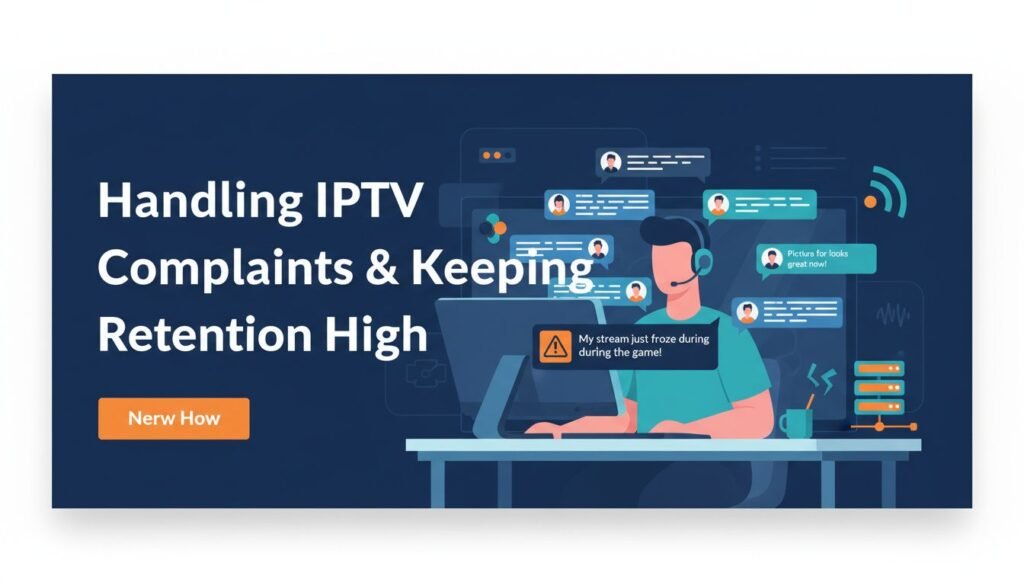
A customer messages you at 10:47pm on a Saturday. Their stream dropped mid-match, Arsenal are 1-0 up, and they want a refund. You have no idea if the issue is on your supplier’s end, their router, or their device. You have three minutes before they leave a bad review somewhere, tell their mate the service is rubbish, and never renew. This is not a hypothetical — this is Tuesday for most active IPTV resellers.
IPTV reseller customer retention does not get decided in a marketing spreadsheet. It gets decided in moments exactly like that one, and how you handle the next five minutes determines whether that customer stays for three years or disappears before their first renewal. Most resellers lose 30 to 40 percent of their base in the first 90 days not because the service is bad, but because nobody taught them how to handle the friction that comes with it.
Why Complaints Are Actually Your Retention Leverage Point
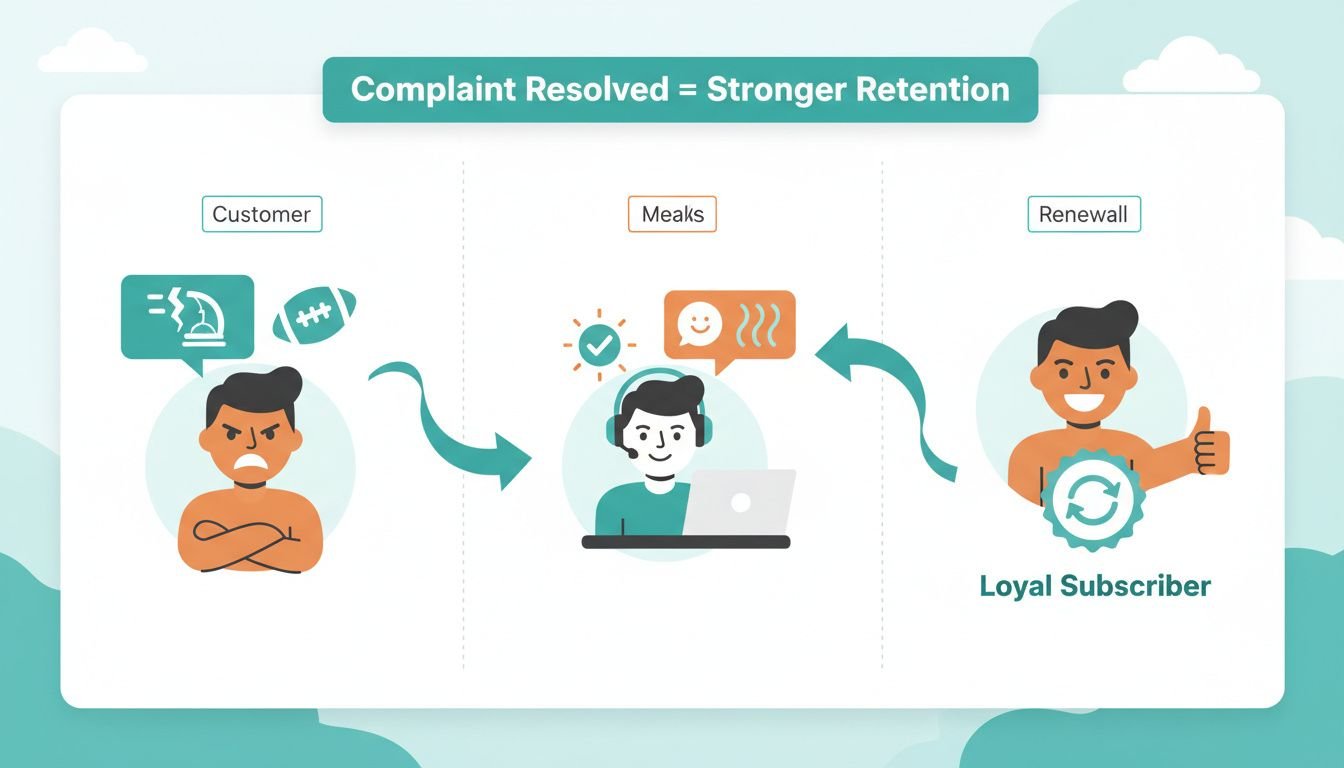
Most resellers treat a complaint as a problem to close. The smarter framing is that a complaint is a customer who has not left yet. Research on customer retention benchmarks for subscription businesses consistently shows that customers who have a complaint resolved well are more loyal than customers who never complained at all. That dynamic applies directly to IPTV. A subscriber who messages you about buffering and gets a fast, clear, helpful response has now seen evidence that you are a real person who cares. That is rare in this industry, and it sticks.
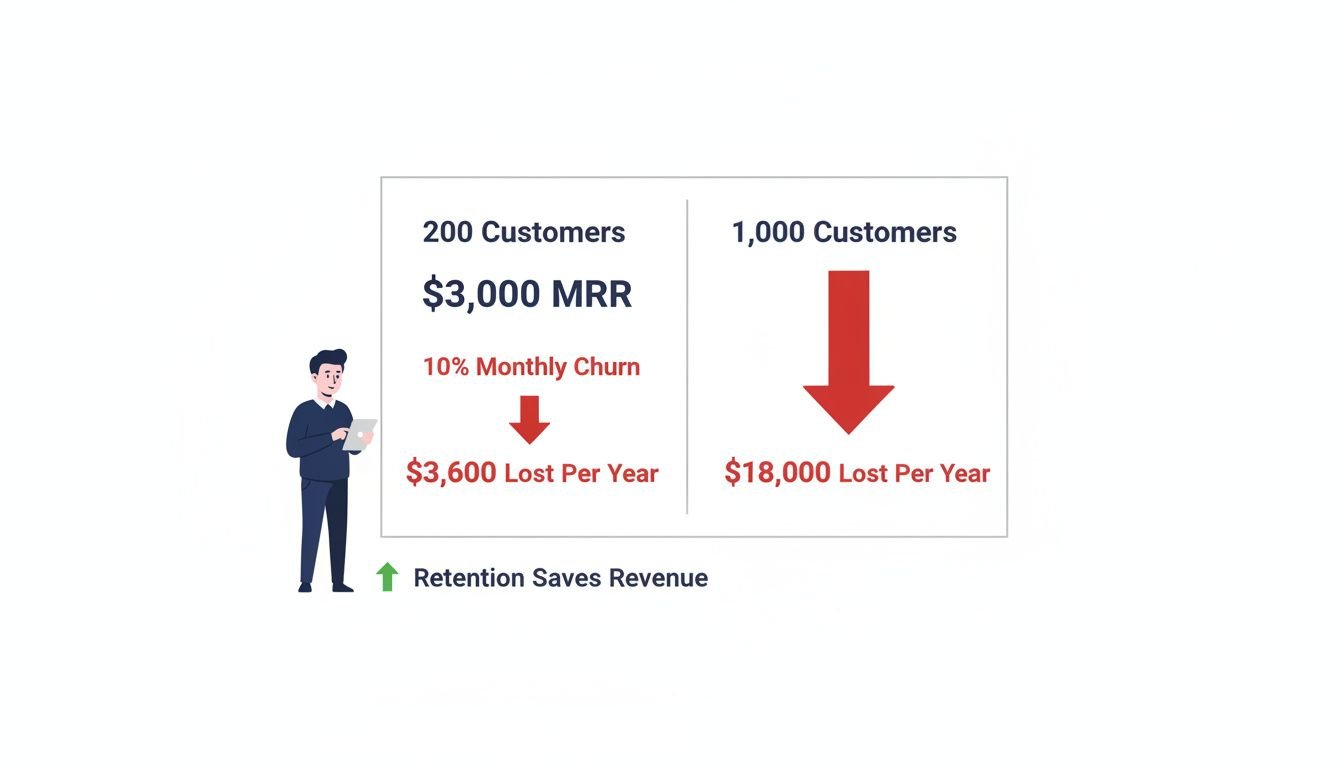
The financial stakes are real. If you are running a modest base of 200 customers at $15 per month, that is $3,000 in monthly recurring revenue. Losing 10 percent of that to churn every month is $300 gone — $3,600 a year — before you have spent a dollar on finding new IPTV customers to replace them. Scale that to 1,000 customers and the math becomes brutal fast. The resellers who build stable income are not necessarily the ones with the best supplier. They are the ones who have stopped treating complaints as interruptions and started treating them as the actual job.
There is also a referral dimension that most resellers undercount. IPTV is still largely sold word of mouth. A customer who feels looked after tells two or three people. A customer who felt ignored or dismissed tells everyone in their WhatsApp group. You do not get to control which story spreads — but you do get to control which one exists in the first place.
The First Response Window Matters More Than the Fix
Speed of initial response is the single biggest variable in whether a complaint escalates or de-escalates. According to subscriber churn prevention in IPTV services research from Infomir, the time between a customer reporting an issue and receiving any acknowledgement is the moment where churn decisions get made. They are not waiting for a fix — they are waiting to see if you exist. A response within five to ten minutes that says “I am looking into this now” does more for retention than a perfect technical resolution that arrives 45 minutes later with no communication in between.
Set a rule for yourself: first response within ten minutes during waking hours, even if that response is just an acknowledgement. You do not need to have the answer. You need to prove you are there.
Building a Complaint-Handling Workflow That Scales
When you are running 50 customers, you can handle every complaint manually and personally. When you are running 300, the same approach will burn you out and still leave customers waiting. You need a workflow that works at scale without making customers feel like they are talking to a ticket system.
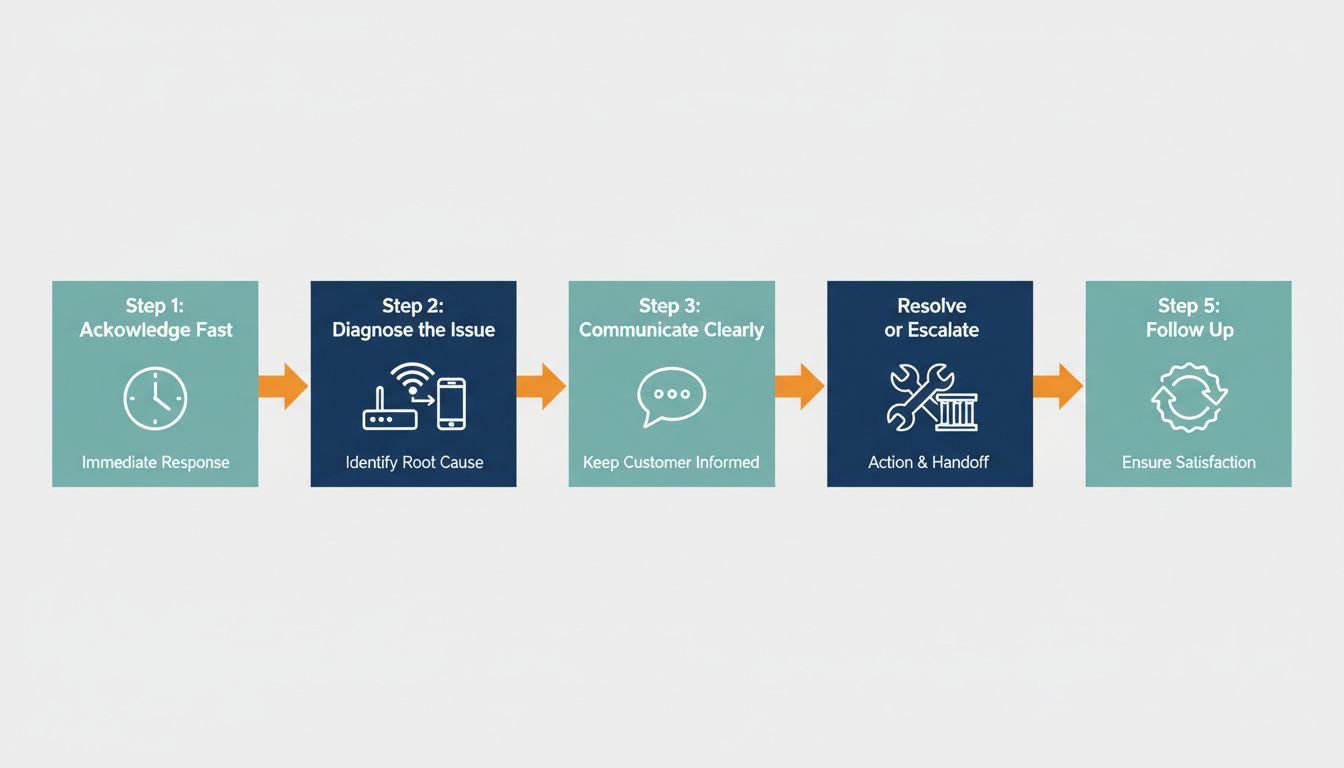
The basic framework has four stages: acknowledge, diagnose, resolve, follow up. Most resellers do the middle two and skip the first and last. That is exactly backwards from what builds loyalty. The acknowledgement is what stops the anger from escalating. The follow-up is what converts a resolved complaint into a retention win.
Triage by Complaint Type Before You Respond
Not every complaint needs the same response. Buffering complaints during a major live event are almost always a supplier-side load issue — your job there is to communicate honestly and buy time, not pretend you can fix it in real time. Buffering complaints on a single customer’s account during off-peak hours are usually a device or internet issue on their end. App crashes are often solved by clearing cache or switching the app version. Channels missing from a playlist are a panel issue you can fix directly.
If you cannot immediately identify which category a complaint falls into, ask one diagnostic question before anything else: “Is this happening on all channels or just one?” That single question separates most complaint types and tells you whether the issue is account-level, device-level, or supplier-level. It also buys you 60 seconds to check your supplier’s status or test the stream yourself.
Getting your support infrastructure right from the start makes this workflow much easier to execute. If you have not already, take the time to set up a proper customer support system with templates, response protocols, and a clear escalation path. Trying to improvise support at scale is how you lose customers you could have kept.
What to Actually Say When a Customer Wants a Refund
Refund requests are the hardest complaint type because they carry a deadline. The customer is not just reporting a problem — they are telling you the relationship is already over in their head unless something changes. Most resellers panic and either cave immediately (losing money and training customers that complaining equals refunds) or get defensive (losing the customer entirely and probably getting a bad review on top of it).
The right move is neither. Acknowledge the frustration first, without admitting fault. “I understand that is genuinely frustrating, especially during a live match — let me see exactly what happened.” That sentence costs you nothing and it changes the emotional temperature of the conversation. Then ask a diagnostic question. Then offer a fix. If the fix works, you have probably saved the subscription. If the fix does not work or is not possible, you have a judgment call to make.
A partial credit — say, two weeks added to their subscription — is often enough to resolve a refund request when the underlying issue was a genuine service disruption. A full refund demand that comes after two months of usage is a different conversation. You are not obligated to refund a service that was delivered for the majority of the subscription period. You can say that politely: “I want to be fair here — the service ran without issues for most of the month, so a full refund is not something I am able to do, but I can add two weeks to your account as goodwill.” Most reasonable customers accept that.
The customers who do not accept any resolution were probably going to churn regardless. Do not let them set your refund policy.
Handling the Renewal Refusal: What to Say When They Say No
A customer whose subscription expires and who does not respond to your renewal message is a lost customer by default. But a customer who actively says “I do not want to renew” is still in conversation with you, and that is an opportunity most resellers completely waste.
The first thing to do is ask why. Not defensively — genuinely. “No problem, can I ask what put you off? I want to understand if there was something I could have done better.” About half the time, the reason is something fixable: they found it too expensive, they had a technical issue they never mentioned, they did not know a particular sports package was included. The other half of the time, the reason is life circumstances — they are cutting spending, they moved, the household watching habits changed. You cannot fix that, and you should not try.
For the fixable reasons, have a retention offer ready. A discounted renewal, an extended trial, or a switch to a shorter subscription period can bring back a customer who was only leaving on price. A one-month renewal at a reduced rate beats zero. You keep the customer in the habit of paying you, you get another 30 days to demonstrate value, and you avoid the cost and effort of replacing them through acquisition.
IPTV Reseller Customer Retention During the Renewal Window
The 72 hours before and after a subscription expires is the highest-risk window for churn. Customers who have been meaning to cancel but have not got around to it will use the expiry as the natural exit point. Getting ahead of that window with a proactive renewal message — not a generic reminder, but a personal one — changes the dynamic. Something like: “Your subscription is coming up for renewal in three days — let me know if you want me to sort it out for you” feels different from an automated payment link. It signals that you are paying attention.
Setting up automated subscription renewals handles the mechanical side of this, but it should not replace the personal touch entirely. Use automation for the reminder and payment processing, but follow it with a brief personal check-in. That combination — efficient process plus human contact — is what keeps long-term customers loyal rather than just subscribed.
IPTV Reseller Customer Retention Through Proactive Communication
Most retention problems are complaint problems that were never given the chance to surface. A customer who has been silently buffering for a week, who never messaged you because they assumed nothing would change, is a customer who is quietly shopping for an alternative. You will not know they are unhappy until they do not renew.
Proactive communication is the practice of reaching out before a problem becomes a complaint. This does not mean spamming customers with updates. It means having a short, regular touchpoint that keeps the relationship alive. A message once a month through using WhatsApp and Telegram for your IPTV business — mentioning an upcoming sports fixture, a new channel addition, or a known maintenance window from your supplier — does three things at once. It demonstrates you are active. It gives customers a low-friction way to raise issues. And it keeps your name in front of them so renewal feels like continuing a relationship rather than buying a new product.
Supplier outages are the moment where proactive communication earns the most loyalty per message. When your supplier goes down, message your affected customers before they message you. “There is a known issue with the service right now — my supplier is working on it and I will update you as soon as it is resolved.” That single message converts what would have been ten angry complaints into ten customers who feel informed and respected. Most of them will wait. Very few will churn if you handled the communication well.
The onboarding phase is also where a significant amount of preventable churn originates. Customers who are not properly set up, who do not understand how to use the app, or who have wrong expectations about what the service includes will complain earlier and louder than customers who were set up correctly from day one. Getting how to onboard a new IPTV customer right is one of the highest-leverage retention moves you can make, because it prevents the complaints that are hardest to recover from.
Tracking Churn Signals Before Customers Tell You They Are Leaving
The best complaint-handling system in the world is reactive. Churn signal tracking is proactive — it lets you intervene before the complaint happens. Most resellers do not do this because their panel does not surface the data in an obvious way, but the signals are there if you look for them.
Customers who stop watching are your highest churn risk. If your panel shows connection logs or last-seen timestamps, a customer who has not connected in 10 to 14 days is a customer who has probably already switched to something else or is seriously considering it. A short check-in message — “Hey, noticed you have not been on lately, everything working okay?” — catches a surprising number of these situations before they become lost renewals. Some of those customers had a device issue they did not bother reporting. Some forgot the app existed. A few had a life event. Almost none of them were expecting you to notice, and that alone changes how they feel about the service.
Complaint frequency is another signal. A customer who has contacted you three times in one subscription period is either about to churn or about to become your most vocal advocate, depending on how those interactions went. Track which customers have had multiple complaints and make sure their renewal is handled personally, not through automation alone.
Price sensitivity spikes around the 90-day mark for most new subscribers. That is when the novelty has worn off and they are assessing whether the service is worth continuing. If you have not checked in with a customer in the first three months, you are leaving that assessment entirely to chance. A brief message around day 75 — “Coming up on your first renewal soon, let me know if you have any questions or if there is anything I can do to make the service work better for you” — opens the door for concerns to surface on your terms rather than as a cancellation notice.
None of this requires expensive software or complex systems. It requires treating the customer base as a list of individual relationships rather than a revenue number, and building the habit of regular, intentional contact. The resellers who sustain 80 to 90 percent annual retention rates are not offering a technically superior service. They are just paying attention in ways their competitors are not.
Frequently Asked Questions
What is the most common complaint IPTV customers make to resellers?
Buffering and stream freezing are by far the most frequent complaints. They are usually caused by the customer's internet connection, device performance, or a temporary issue on the supplier's server. Diagnosing which factor is responsible before responding saves time and prevents unnecessary credit refunds.
How do I stop IPTV customers from cancelling after a service outage?
Contact them before they contact you. If you know a supplier outage is happening, send a proactive message with an estimated fix time. Customers who receive a heads-up are significantly less likely to churn than those who feel ignored. A small goodwill credit extension also helps absorb the frustration.
How should I handle a customer demanding a refund for IPTV downtime?
Avoid cash refunds where possible. Instead, offer a subscription extension of equivalent value. Frame it as adding days to their account rather than disputing the complaint. Most customers accept this if the response is fast and the tone is professional. Document the resolution in case the issue recurs.
What is a realistic IPTV churn rate for a small reseller?
Monthly churn between 5 and 10 percent is common for resellers who do not actively manage retention. Resellers with a structured support process, proactive renewal reminders, and fast complaint resolution typically hold churn below 5 percent. At 500 customers, that difference is worth thousands of dollars annually.
How many support channels does an IPTV reseller actually need?
One well-managed channel beats three neglected ones. Most resellers operate effectively with WhatsApp or Telegram as the primary support channel and email as a backup. What matters is response time and consistency, not the number of channels. Customers who get a reply within an hour rarely escalate or churn.