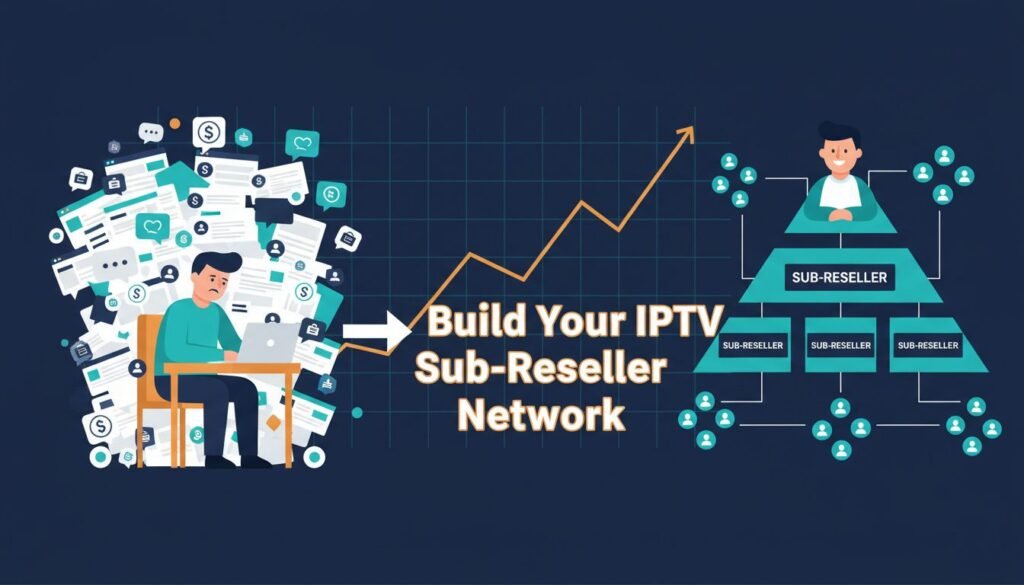
A reseller with 60 active customers hit out to a forum last year describing what he called “the ceiling problem.” He was spending four hours a day on support tickets, chasing payment renewals, and manually creating subscriptions. His margin per customer was around $6 after wholesale costs. To hit $3,000 a month he needed 500 customers — alone. The math was never going to work. What he had not considered was building an IPTV sub-reseller network beneath him, where other operators handle their own customers, and he earns a spread on every credit they consume.
That structural shift changes everything about how this business scales. Instead of trading time for subscriptions, you build a distribution layer that operates partly without you. This guide walks through exactly how to construct that layer — the margin math, the panel mechanics, the recruitment approach, and the risk management that most people skip entirely.
Why the Direct-to-Customer Model Hits a Wall Around 100 Subscribers
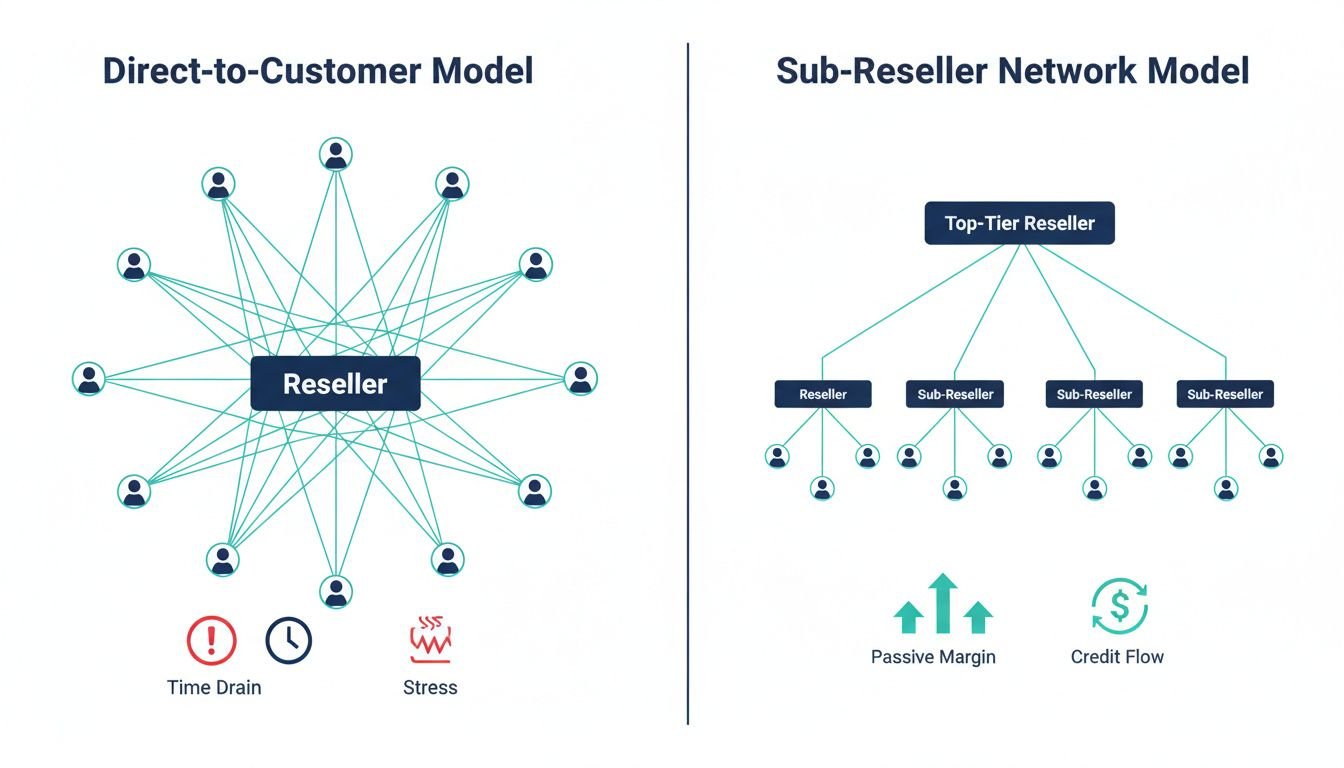
Most people who learn how to start an IPTV reseller business are taught to sell subscriptions directly to end users. That works at small scale. Under 50 customers, one person can handle support, renewals, and onboarding without much friction. The cracks appear somewhere between 80 and 120 active lines.
At that point, support volume becomes its own job. You have customers on different devices, different apps, different time zones. A stream goes down at 11pm on a Saturday and three people message simultaneously. Your wholesale provider has a hiccup, and suddenly you are the one absorbing 40 complaints about something you cannot control. The churn rate climbs because your response times slip. Most new resellers who price at $10 per month and run 100 customers see 35 to 45 percent monthly churn before they figure out why — and the answer is almost always support quality degrading under volume.
The other problem is credit capacity. If you are buying credits at $2.50 to $4.00 each from a wholesale supplier, your working capital is constantly tied up in pre-purchased inventory. Adding customers means adding credit purchases. Your cash flow tightens exactly when your customer base grows. That is the opposite of how a scalable business is supposed to work.
The Margin Ceiling That Most Resellers Never Calculate
Run the numbers honestly. If you buy at $3 per credit and sell subscriptions at $10 per month, your gross margin is roughly $7. After PayPal fees, occasional refunds, and the time cost of support, you are probably netting $4 to $5 per customer per month. At 100 customers, that is $400 to $500 monthly. To clear $2,000 a month, you need 400 to 500 active lines under direct management. One person cannot reliably support 400 customers without the quality collapsing.
The sub-reseller model breaks that ceiling. Instead of adding customers, you add operators who each bring their own customers. Your margin per credit consumed drops, but your volume scales without your support burden scaling with it. You can find a detailed breakdown of the underlying numbers at how to calculate your IPTV reseller profit margin — it is worth running your own figures before you commit to a structure.
According to global IPTV market growth projections from Grand View Research, the IPTV market is expanding at a compound annual rate that suggests significant headroom for distribution-layer operators. The demand is there. The question is whether your business structure can capture it without burning you out.
How to Structure Pricing Tiers Inside an IPTV Sub-Reseller Network
This is the part nobody writes about, and it is the part that determines whether recruiting sub-resellers actually makes you money or just creates a management headache for thin returns.
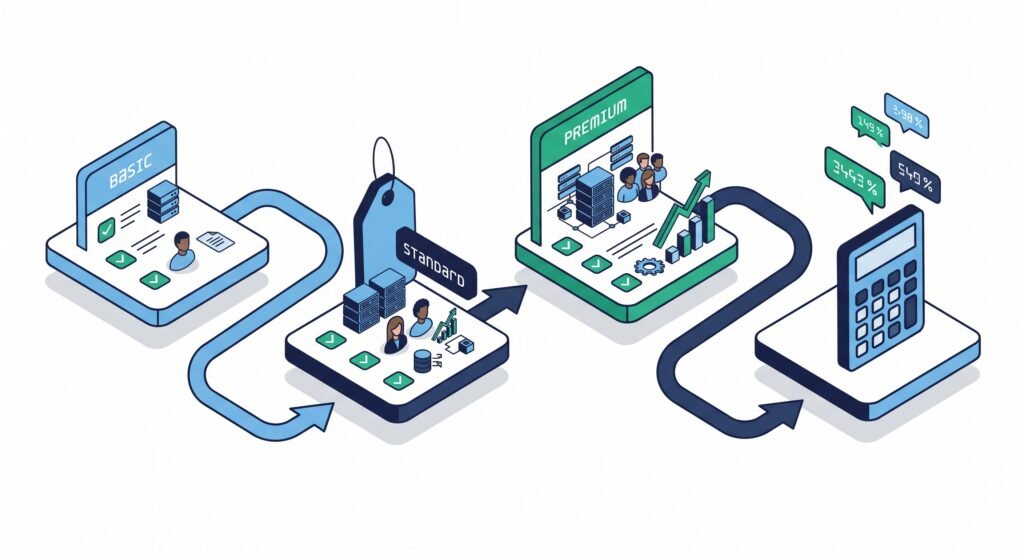
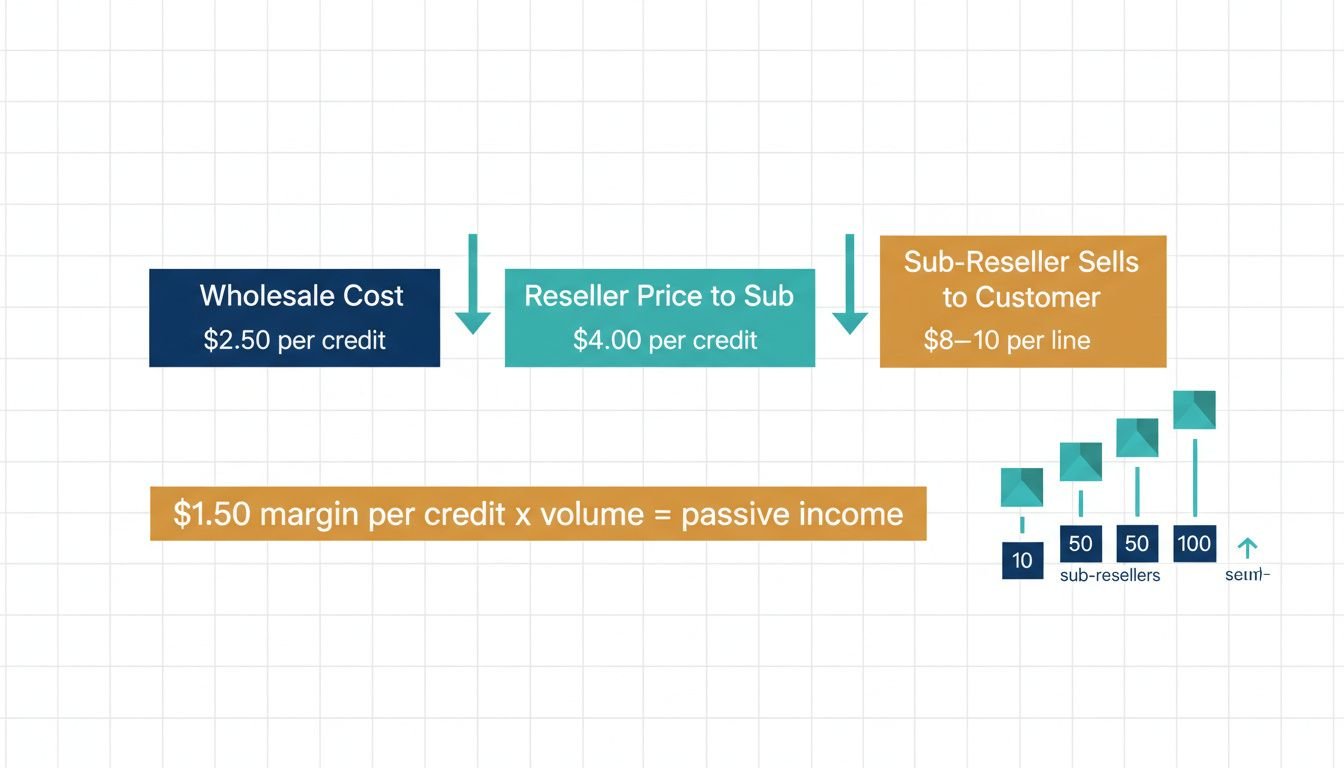
Start with your wholesale cost. If you are buying credits from your panel supplier at $3 each, you need to sell to sub-resellers at a price that gives them enough margin to operate their own customer-facing business while still leaving you a worthwhile spread. A common working structure looks like this: wholesale cost at $3, your sub-reseller price at $5, sub-reseller’s end-user price at $8 to $12. You make $2 per credit consumed. They make $3 to $7 per subscription sold. Everyone has a viable margin.
The exact numbers depend on your own wholesale rate and your market. If you are sourcing from a supplier that offers volume discounts — dropping your cost to $2.50 at 500 credits per month — your sub-reseller tier becomes more attractive because you can price more competitively while maintaining your spread. This is one reason why your choice of wholesale supplier matters more once you start building a distribution layer. Lukkystreams is a global M3U wholesale supplier built specifically for operators scaling into sub-reseller structures — they offer tiered credit pricing and panel infrastructure that supports multiple reseller levels, which is worth evaluating if your current supplier is capping you on volume or charging flat rates regardless of consumption.
Setting Minimum Credit Purchase Requirements for Sub-Resellers
One mistake that costs resellers real money is allowing sub-resellers to buy credits in single units with no minimum commitment. That creates a situation where you have 15 sub-resellers each buying 5 credits a month. Your administrative overhead is high, your volume discounts from your own supplier are not triggered, and half of those sub-resellers go inactive within 60 days without you noticing until you audit.
Set a minimum monthly credit purchase. Fifty credits per month is a reasonable floor for a working sub-reseller. That represents roughly 50 active customer lines, which is a manageable operation for someone running a side business. It also signals commitment. A sub-reseller who will not commit to 50 credits per month probably does not have a customer base yet, and you do not want to grant panel access to someone who is going to experiment with two customers and disappear.
Structure your tiers by volume: 50 to 99 credits per month at one price, 100 to 249 at a lower per-credit rate, 250 and above at your best rate. This mirrors how tiered distribution models work in digital services across legitimate software and content industries — reward volume, create incentives to grow, and make the economics self-reinforcing.
Panel Access, Permissions, and Preventing Credit Overselling
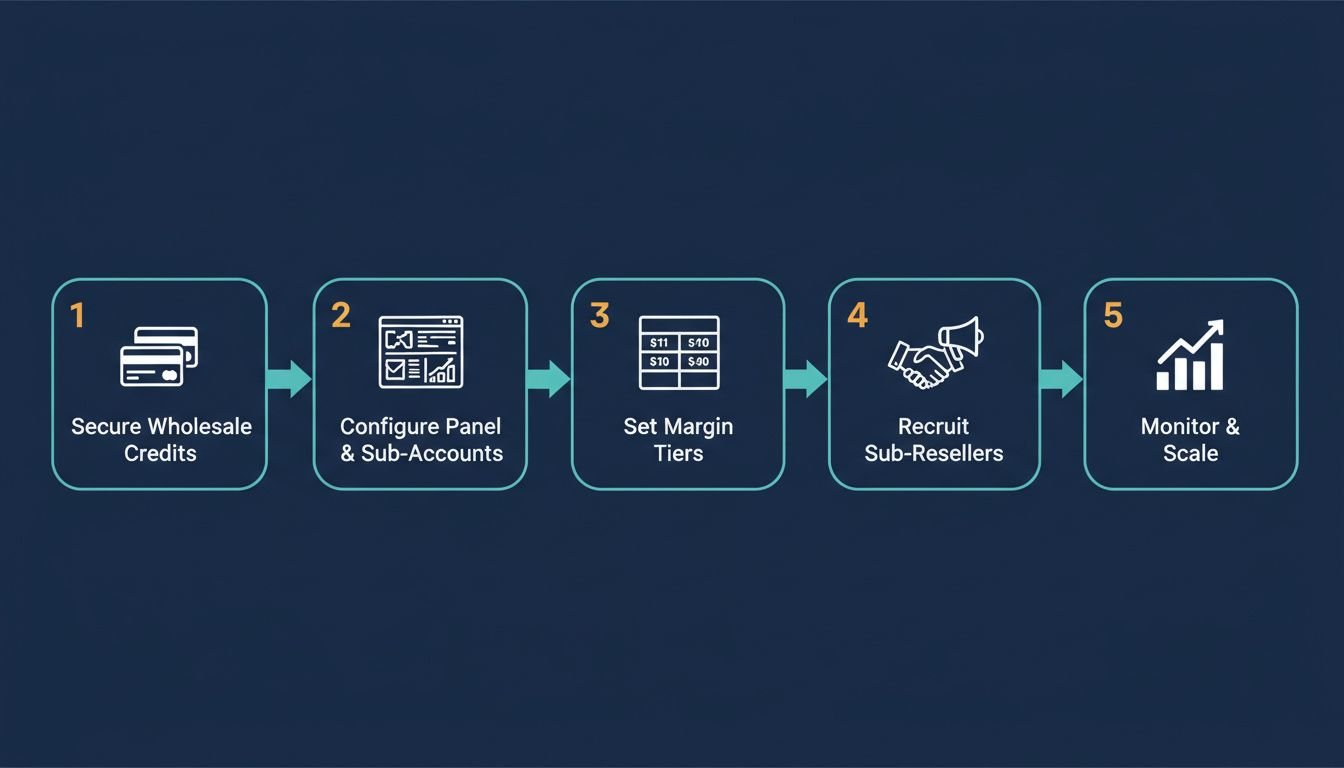
Most IPTV reseller panels — Xtream Codes derivatives, XCIPTV-based systems, and similar platforms — have a sub-reseller functionality built in. You can create a reseller account under your main account and allocate a credit balance to it. The sub-reseller logs in with their own credentials, creates subscriptions for their customers, and draws down from the credit balance you have assigned. You see everything they create from your admin view.
Understanding how the IPTV reseller credit system works at the panel level is essential before you start assigning sub-reseller access. Credits are not refunded when subscriptions expire — they are consumed on creation. If a sub-reseller creates a 12-month subscription using 12 credits and the customer cancels after two weeks, those credits are gone. You need to make sure your sub-resellers understand this before they have access, because inexperienced operators will make expensive mistakes with your credit allocation.
The specific permissions you grant matter. Most panels allow you to restrict sub-resellers from creating subscriptions longer than a set duration, from accessing the full channel list, or from viewing other sub-resellers under your account. Use these controls. A new sub-reseller should start with monthly subscription creation only, a capped credit balance, and no visibility into your other accounts. Expand permissions as they demonstrate they know what they are doing.
How to Audit Sub-Reseller Activity Without Micromanaging
Set a weekly review cadence for the first 90 days with any new sub-reseller. Look at three things: credits consumed versus credits allocated, active line count versus what they reported when you onboarded them, and any unusual subscription patterns like a spike in short-duration accounts that might signal churn problems on their end.
After 90 days of clean operation, you can move to monthly reviews. The goal is not to babysit — it is to catch problems before they become your problem. A sub-reseller who runs out of credits and cannot renew their customers will create a support crisis that lands back on you if you are not paying attention. Build a simple spreadsheet, check it weekly, and you will catch 90 percent of issues before they escalate.
Where to Find and Vet Sub-Resellers Worth Recruiting
The recruitment problem is real. You cannot post a job ad for IPTV sub-resellers on mainstream platforms. The business operates in a gray area in most jurisdictions, which means your recruitment channels are limited to communities where this industry is openly discussed.
The most productive sources are IPTV-specific forums and communities — BlackHatWorld’s IPTV section, Reddit communities like r/IPTVResellers, Telegram groups focused on IPTV trade, and Discord servers where resellers congregate. These are places where people already understand the business model and are actively looking for either a better supplier or a way to expand their operation. A reseller who already has 20 customers and wants to grow is a far better prospect than someone who has never sold a subscription.
Facebook groups remain a surprisingly active recruitment ground despite platform restrictions. Private groups dedicated to IPTV reselling exist in significant numbers, and within them you will find operators at every stage — from people just starting to experienced resellers who want to move upstream and earn margin without managing end users directly.
Your pitch should be simple and specific. Show your panel. Show the credit pricing. Show the channel count and uptime record. Tell them what the minimum buy-in is and what support you provide. Do not oversell. Experienced operators will ask hard questions about uptime history, payment methods, and what happens when streams go down. Have real answers.
Vetting matters more than volume. Three reliable sub-resellers operating at 100 credits per month each are worth more than fifteen inconsistent ones. Before granting panel access, ask for proof they have existing customers — a screenshot of their current reseller panel, a reference from their current supplier, or even a brief call. Someone who cannot provide any evidence of an existing customer base should not get access to your panel on credit. Start them with a prepaid credit allocation only, no credit terms.
Managing Support When Your IPTV Sub-Reseller Network Grows
The support structure is where most resellers who build a sub-reseller layer make their first serious operational mistake. They assume that because sub-resellers handle their own customers, support disappears. It does not — it shifts.
Your sub-resellers will have questions. Their customers will have issues that escalate past the sub-reseller’s ability to fix them. Your wholesale provider will have outages that require you to communicate upstream information quickly to multiple operators simultaneously. The support burden changes shape rather than disappearing, and if you do not build a structure for it, you end up in a worse position than you were managing end users directly — because now you have sub-resellers who feel entitled to direct support while also managing their own customer complaints.
Build a tiered support system from day one. Your sub-resellers are your first line of support for their customers. You are the second line for issues they cannot resolve — panel problems, stream quality issues that affect the whole network, credit discrepancies. Your wholesale supplier is the third line for infrastructure problems you cannot control. Every sub-reseller you onboard should understand this structure before they get panel access.
For practical communication, a dedicated Telegram group for your sub-resellers only is the most effective tool in this space. It is fast, it keeps communication history, and it lets you broadcast status updates during outages to everyone at once. When your provider has a 20-minute downtime at 7pm, one message to the group stops 10 sub-resellers from each sending you individual panic messages. That alone saves significant time.
Document everything you tell sub-resellers. A simple shared Google Doc with your pricing, panel access instructions, common troubleshooting steps, and escalation process takes two hours to build and saves hundreds of hours over the life of your network. Sub-resellers who onboard themselves with good documentation are also less likely to make the expensive panel mistakes covered in the previous section.
Risk Management When Sub-Resellers Go Dark or Stop Paying
This happens. A sub-reseller builds up to 80 customers, goes quiet for two weeks, and you realize they have not topped up their credit balance. Their customers start losing service. The sub-reseller is not responding to messages. You are now managing a mini-crisis that you did not create.
The first protection is never extending credit terms to sub-resellers until they have a track record. Prepaid only for the first six months. They buy credits before they use them. If they stop paying, their customers lose service — that is between them and their customers. Your exposure is zero. Credit terms are something you earn after demonstrating consistent payment over time, not something new operators receive as standard.
The second protection is keeping sub-reseller credit balances low relative to their actual consumption rate. If a sub-reseller is consuming 50 credits per month, there is no reason for them to hold 300 credits in their account. Top up frequently in smaller amounts rather than loading large balances that you are exposed to if the relationship breaks down.
The third protection is having a clear written agreement, even if it is just a message thread that documents the terms. Credit price, minimum monthly purchase, payment schedule, what happens to active subscriptions if the account is terminated. When a sub-reseller disputes a credit charge or claims they were overcharged, you want a documented record of what was agreed. Screenshots of the conversation where terms were laid out have resolved more payment disputes than any formal contract in this industry.
Plan for provider risk as well. If your wholesale supplier disappears — and suppliers do go dark, sometimes without warning — your entire IPTV sub-reseller network is exposed. The best insurance is maintaining a tested backup supplier relationship before you need it. Know the best IPTV M3U wholesale suppliers for resellers and have credentials with at least one alternative ready. A 48-hour migration window to a backup provider is survivable. Two weeks of downtime while you scramble to find a new source is not. Running a network of sub-resellers amplifies both the impact of provider failure and the reputational cost — your sub-resellers will not wait patiently while you sort out a supplier problem. Have the contingency built before the crisis.
For those ready to move beyond the mechanics and into the actual growth strategy, scaling your IPTV reseller business from 50 to 500 customers covers the operational decisions that sit above the sub-reseller layer — staffing, automation, and the point at which your network generates genuinely passive income rather than just a different kind of management workload.
Frequently Asked Questions
What is an IPTV sub-reseller network?
An IPTV sub-reseller network is a tiered structure where you, as the main reseller, recruit other resellers beneath you. You supply them with credits or connections at a wholesale rate, they sell to end users at retail, and you earn a margin on every subscription they activate without handling those customers directly.
How many customers do I need before building a sub-reseller network?
Most resellers start recruiting sub-resellers after reaching 50 to 100 active end users. At that point you have enough operational experience to train others, a proven supplier relationship, and enough volume to negotiate credit pricing that leaves a viable margin for both you and your sub-resellers.
How do I price credits for my sub-resellers?
Buy credits from your wholesale supplier at the lowest available tier, then mark them up 30 to 50 percent for sub-resellers. Sub-resellers still need room to profit on retail sales, so your markup should leave them a margin of at least 40 percent above what they pay you. Test the math before recruiting.
How do I find people to become sub-resellers under me?
Start with your existing customer base — satisfied users who ask how the service works are natural candidates. Facebook groups, WhatsApp communities, and Telegram channels focused on cord-cutting or streaming are also productive. Diaspora communities with strong demand for specific regional content often produce motivated sub-resellers.
What panel features do I need to manage sub-resellers?
You need a panel that supports multi-tier account creation, letting you assign a credit balance to each sub-reseller who then manages their own end users independently. Look for panels with usage visibility per sub-account, expiry controls, and the ability to top up credits remotely without manual intervention.