
You sign up with a wholesale IPTV supplier, load $500 in credits, start onboarding your first 30 customers, and three weeks later the panel goes dark. No warning. No refund. The Telegram support channel stops responding at 2am and never comes back. That scenario plays out more often than any supplier directory will tell you, and it is the reason finding the best IPTV M3U wholesale supplier is not a five-minute Google job.
The global IPTV market size and growth projections look attractive on paper, but the wholesale layer of that market is still littered with one-man operations running rented servers and reselling access they do not own. Knowing how to separate the serious infrastructure players from the fly-by-night resellers is the skill that actually determines whether your business survives past month three.
Why the Alibaba Search Result Is Not What You Think It Is
Type “IPTV M3U wholesale supplier” into Google and you will see Alibaba, Global Sources, and Made-in-China dominating the first page. Most new resellers click those links and assume they have found the right category of supplier. They have not. What those marketplace listings actually show you is a mix of Chinese hardware exporters selling IPTV boxes in bulk and playlist aggregators offering raw M3U files with no supporting infrastructure. The distinction matters enormously.
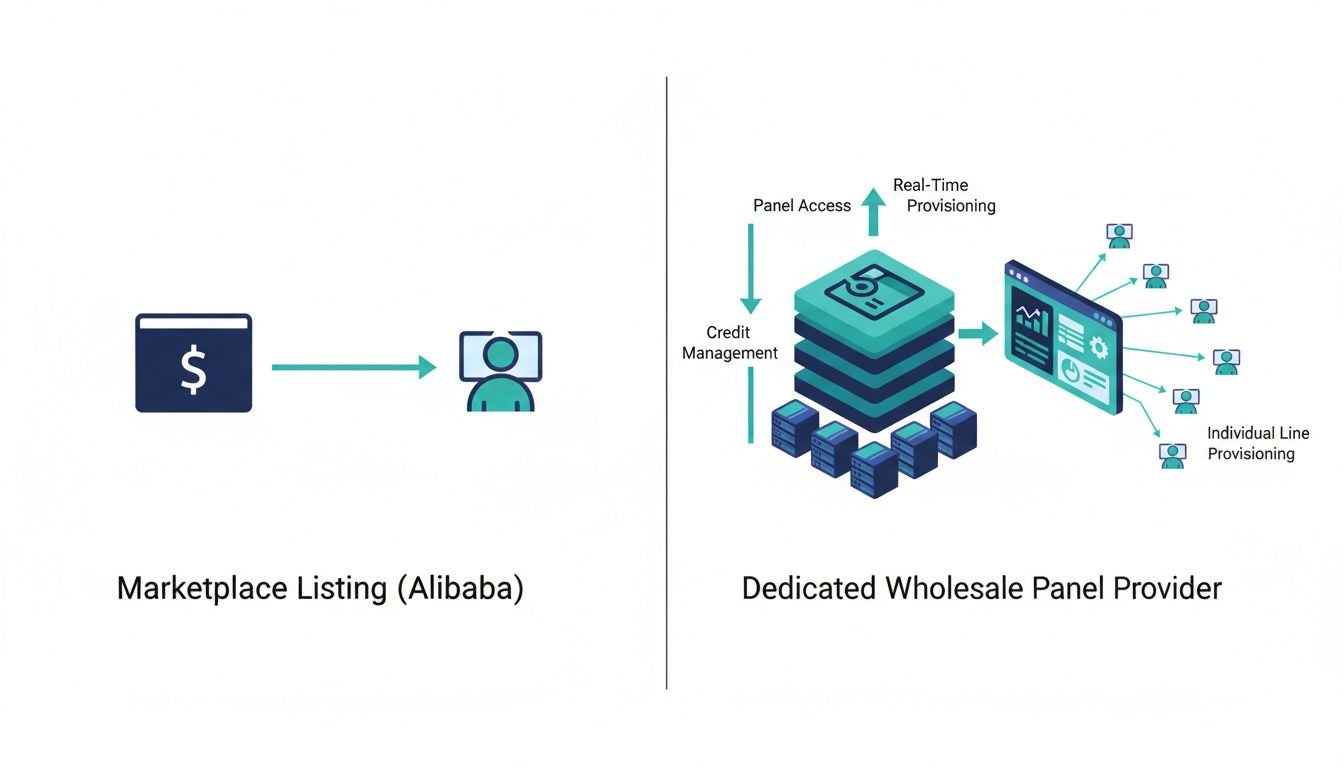
A listing on Alibaba from a company like Shenzhen Meilaike Electronics or Jinjiang Lailin Import and Export Trading gives you a price range of $1 to $24 per subscription and a minimum order quantity as low as one piece. That sounds appealing. What it does not give you is a reseller control panel, real-time line provisioning, credit management tools, or any mechanism for managing your customer base at scale. You are buying a product, not joining a wholesale infrastructure.
The difference between buying a bulk M3U playlist and working with a dedicated IPTV wholesale panel provider is roughly equivalent to the difference between buying a pallet of phone cases and becoming an authorised distributor with your own storefront backend. One is a transaction. The other is a business relationship with operational infrastructure attached.
What a Real Reseller Panel Actually Gives You
A proper reseller panel lets you create, suspend, and renew customer lines without contacting the supplier each time. You see live connection data, active device counts, and expiry dates in one dashboard. You can issue trial lines to prospects without burning full credits. You get an API in many cases, which means you can automate provisioning if you build a simple order flow. None of that exists in a bulk M3U playlist purchase. If you are running more than 20 customers, the absence of panel infrastructure will cost you hours every week in manual account management — and that is before you deal with any technical issues.
Understanding M3U vs IPTV panel: which wholesale model works better is the foundational decision you need to make before you approach any supplier. It shapes every other choice in your setup.
The Real Criteria for Evaluating an IPTV M3U Wholesale Supplier
Most comparison content in this space lists supplier names and calls one of them a winner after vague “testing.” That is not how you should be thinking about supplier evaluation. The criteria that actually determine whether a wholesale relationship works for your specific business are more granular than any top-ten list suggests.
Start with channel count and VOD library depth. A supplier advertising 20,000 channels sounds impressive until you realise 14,000 of those are duplicates across different resolutions or dead streams. What matters is the number of reliably working channels in the geographic markets you serve. If your customer base is primarily UK viewers, you need consistent delivery of Sky Sports, BT Sport, BBC iPlayer, and ITV. If you are targeting North American customers, US and Canadian sports rights are the stress test. A 99% uptime rate across a 20,000-channel library means nothing if the 1% that goes down is the Premier League on a Saturday afternoon.
Simultaneous connections per line is another number that gets glossed over. Most household customers want two to four connections. If your supplier caps lines at one connection and you are selling family packages, you will hear about it constantly. Check this before you commit credits.
Anti-Freeze Technology and Server Architecture
Buffering is the single most common customer complaint in IPTV. The technical cause is usually server congestion or a weak CDN setup, not the customer’s internet speed. Legitimate wholesale suppliers invest in anti-freeze systems and load-balanced server clusters that redistribute traffic during peak demand. When you are vetting a supplier, ask them directly how their infrastructure handles concurrent load spikes during major live events. If they cannot answer that question in technical terms, they probably do not have a real answer. Understanding streaming server uptime and SLA benchmarks gives you enough background to ask intelligent questions and recognise when a supplier is giving you a marketing answer instead of a technical one.
Geographic server distribution also matters. A supplier with servers only in Europe will deliver poor performance to customers in North America during peak hours, regardless of what the headline uptime figure says. Ask where their CDN nodes are located.
Geographic Specialisation: Matching Supplier Strength to Your Customer Base
One of the most consistent mistakes resellers make is choosing a supplier based on price and total channel count without checking whether that supplier actually delivers well in the specific markets they serve. Wholesale IPTV suppliers are not all-purpose streaming platforms. They have genuine strengths and genuine weaknesses by geography, and those differences are significant enough to determine your churn rate.
UK and European content is a specific infrastructure challenge. Live sports rights in the UK — Sky, BT, TNT Sports — require reliable stream sources that get updated quickly when original feeds change. Suppliers with strong UK operations typically have dedicated UK server clusters and update their stream sources faster after broadcaster changes. Suppliers that treat UK content as a secondary market often have noticeably more freeze events and dead streams on exactly the channels UK customers care about most.
North American markets have a different profile. US customers tend to prioritise local network affiliates, regional sports networks, and premium cable channels. Canadian customers have distinct French-language content requirements if you are serving Quebec. Latino content is a large and growing segment, and the best IPTV M3U wholesale supplier for a reseller targeting that demographic will look completely different from the best option for a UK sports-focused reseller.
Arabic and South Asian Content Tiers
Arabic and South Asian content packages represent some of the highest-demand wholesale categories in the market right now. MBC, beIN Sports, OSN, and regional Arabic channels have extremely active viewer bases that generate consistent subscription renewals. South Asian content — particularly Zee TV, Sony LIV, Star Plus, and cricket — has a similarly loyal audience. If you are targeting either demographic, you need a supplier that specifically prioritises those markets, not one that includes them as a footnote in a 20,000-channel bundle. Ask for a specific channel list before you commit. Test the actual streams, not just the count.
Credit Systems, Pricing Tiers, and Where Your Margin Actually Lives
Understanding how to calculate your IPTV reseller profit margin starts with understanding how wholesale pricing structures actually work. Most dedicated IPTV wholesale suppliers operate on a credit system rather than a per-line subscription model. You buy a block of credits upfront, and each line you provision to a customer costs a set number of credits per month. The per-line cost drops as your credit purchase volume increases.
Typical wholesale pricing in 2026 runs from roughly $1.50 to $6 per line per month depending on channel count, VOD depth, and credit volume. A reseller buying 50 credits at a time pays more per line than a reseller buying 500 credits at a time. That tiered structure means your margin improves as you scale — but it also means you carry more upfront financial exposure as you grow.
Most resellers running sustainable operations target a 3x to 5x markup on their wholesale cost. If you are paying $3 per line wholesale, you need to be selling at $9 to $15 retail to have enough margin to absorb churn, handle support overhead, and cover payment processing fees. Most new resellers set their price at $10 and hit 40% monthly churn before they understand why. The pricing is not the problem. The churn is caused by supplier quality issues and inadequate customer onboarding. Fix those two things first, then think about pricing strategy. The how to price your IPTV reseller service framework gives you a structured way to work backwards from your target margin.
Watch for suppliers that do not offer credit rollover. If unused credits expire at the end of a billing period, you are being pushed into over-purchasing. A supplier confident in their retention rates does not need to build expiry pressure into the credit system.
Red Flags That Should End a Supplier Conversation Immediately
The best IPTV M3U wholesale supplier relationship you will ever have started with a supplier that was willing to answer hard questions before you spent a dollar. The worst relationships in this business start with suppliers that deflect technical questions, rush you toward a credit purchase, and disappear the moment something goes wrong. Here is what to watch for.
No trial line available. Any serious wholesale supplier will give you a test line, typically 24 to 48 hours, before you commit to a credit purchase. If a supplier refuses to provide a trial or asks you to pay even a nominal fee for it, that is a signal. They either know the service will not hold up under scrutiny, or they operate a volume model where they do not care about your long-term retention. Walk away.
Support only through Telegram with response times measured in days. Telegram is a legitimate support channel in this industry. Telegram-only support with no ticket system, no panel-based support function, and no response outside of business hours in a specific time zone is a different thing entirely. When a supplier goes down at 11pm on a Saturday — and they will — you need to know someone is monitoring the infrastructure. Ask specifically how they handle after-hours outages and what their SLA is for critical stream failures.
Vetting a Supplier’s Infrastructure Claims
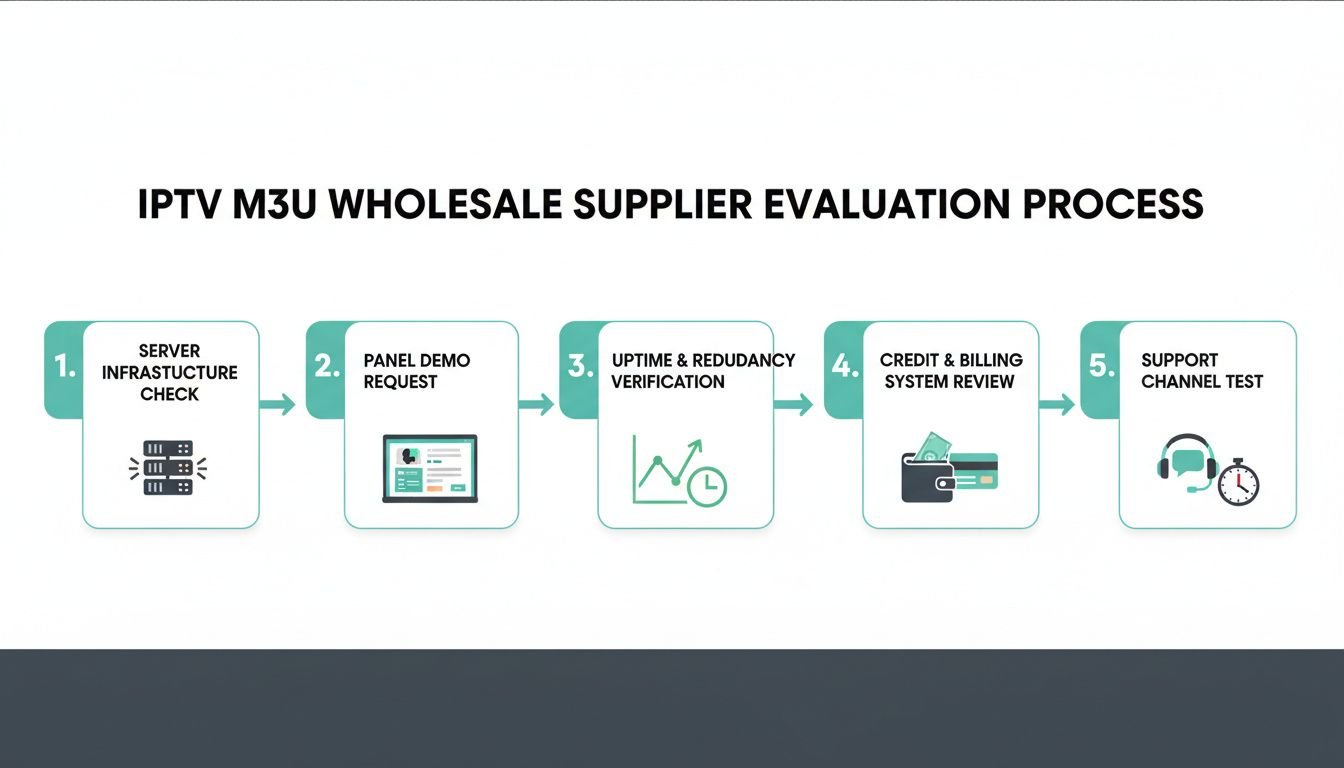
Suppliers will tell you they have 99.9% uptime, 20,000 channels, and anti-freeze technology on every stream. Almost none of them will back that up with any documentation. There are a few ways to pressure-test the claims. First, request the trial line and test it yourself during peak hours — specifically weekend evenings when server load is highest. Second, look for the supplier in IPTV reseller communities and forums. Not review sites that the supplier controls, but independent discussions where resellers share unfiltered experiences. Third, ask the supplier for a sample of their server status reporting or monitoring data. A supplier running serious infrastructure will have uptime monitoring tools. Ask to see a screenshot of their status dashboard.
Payment methods also tell you something. A supplier that accepts only cryptocurrency with no alternative payment option is not necessarily a scam, but it does mean you have no payment dispute mechanism if things go wrong. The more payment options a supplier accepts — including PayPal, credit card, or wire transfer — the more financially accountable they typically are. Read more about how reseller business models work in digital services to understand the financial exposure structure you are stepping into.
How to Structure Your Supplier Relationships to Reduce Risk
Every experienced IPTV reseller who has been in the business for more than two years has a story about a supplier going dark. The ones who survived it had a backup. The ones who lost their customer base had put everything into a single supplier relationship with no contingency plan.
The practical approach is to work with two suppliers simultaneously. Your primary supplier handles the bulk of your customers and your credits. Your secondary supplier is a smaller relationship — maybe 10 to 20% of your customer base — with a different infrastructure footprint. When your primary supplier has an outage, you can migrate affected customers to the secondary temporarily. This is not a perfect solution. Customer migration is operationally messy. But it is dramatically better than telling 200 customers their service is down and you have no timeline for resolution.
Diversifying by geographic strength makes this dual-supplier approach more logical. If your primary supplier has strong UK and European infrastructure but weaker North American delivery, your secondary supplier can be specifically chosen for North American strength. You are not duplicating your infrastructure — you are complementing it.
Keep your credit exposure manageable. Do not load six months of credits with a supplier you have only worked with for three weeks. Build the relationship incrementally. Start with a one-month credit purchase, evaluate the service quality, then scale your credit commitment as the supplier earns it. The how to choose a wholesale IPTV supplier framework covers this evaluation process in detail and gives you a structured checklist for the vetting phase.
Document your supplier relationships. Keep records of your panel login, the supplier’s Telegram or contact details, your credit purchase history, and any support conversations. When a supplier goes dark and you need to reconstruct what happened for a chargeback claim, that documentation is the difference between recovering some money and losing everything.
Technical Setup Considerations That Most Resellers Overlook
Finding the best IPTV M3U wholesale supplier is only half the equation. How you deploy that wholesale service to your customers determines whether the quality holds up end-to-end. A supplier delivering excellent streams to a reseller who sets up customer accounts with no bandwidth guidance, no device configuration support, and no buffer management advice will still generate complaints. The technical layer between wholesale and retail is your responsibility.
M3U playlist delivery versus dedicated IPTV application delivery matters here. An M3U URL handed to a customer who loads it into a poorly configured player on a congested home network will perform worse than the same stream delivered through a properly configured IPTV application with adaptive bitrate support. Understanding what your supplier delivers and what the customer-side setup requirements are is part of your job as a reseller. The IPTV reseller technical setup guide covers the practical configuration steps in detail.
DNS configuration is another underrated factor. Some IPTV suppliers route their streams through specific DNS infrastructure. Customers using default ISP DNS can experience resolution failures that look like stream quality issues but are actually DNS timeout problems. Providing your customers with simple DNS configuration instructions as part of onboarding reduces a significant proportion of first-week support tickets.
EPG data quality is something customers notice immediately. An electronic programme guide that shows wrong titles, missing schedules, or generic channel descriptions makes the service feel cheap regardless of actual stream quality. Check whether your wholesale supplier provides EPG data as part of the panel setup, and if not, how you will source and configure it for your customers. This is a detail that separates resellers who look professional from resellers who look like they set up the service in an afternoon.
Finally, think about how you will handle customer-side device support. IPTV runs on Android boxes, Amazon Fire Sticks, Smart TVs, iOS devices, and MAG boxes. Each platform has different configuration requirements and different failure modes. You do not need to be a technical expert on every device, but you need to know enough to walk a customer through basic setup on the three or four most common devices in your market. Build a simple knowledge base for this early. It will save you hours of support time every week as your customer base grows.