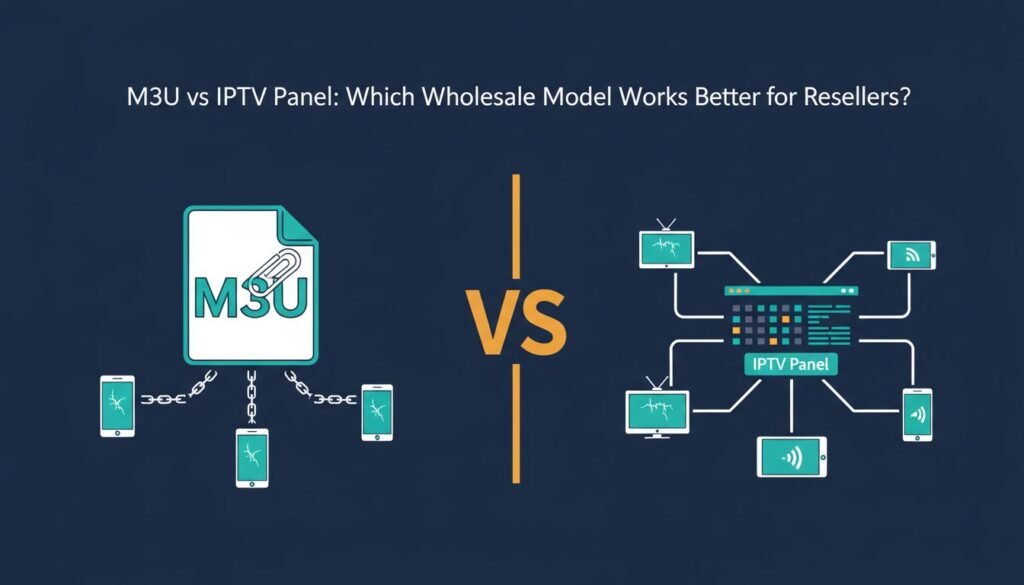
Most new resellers pick the wrong wholesale model before they ever sign their first customer. The M3U vs IPTV panel decision looks like a technical question on the surface — which format, which app, which link. It is not. It is a business structure decision that determines your margins, your churn rate, your support burden, and whether you can actually scale past 30 customers without everything falling apart.
Resellers who start with raw M3U links because the barrier to entry is lower often find themselves rebuilding from scratch six months later when a supplier goes dark and they have no customer management infrastructure to migrate. Understanding the difference between these two wholesale models before you commit money is the most important decision you will make in this business.
What M3U Playlist Distribution Actually Means as a Business Model
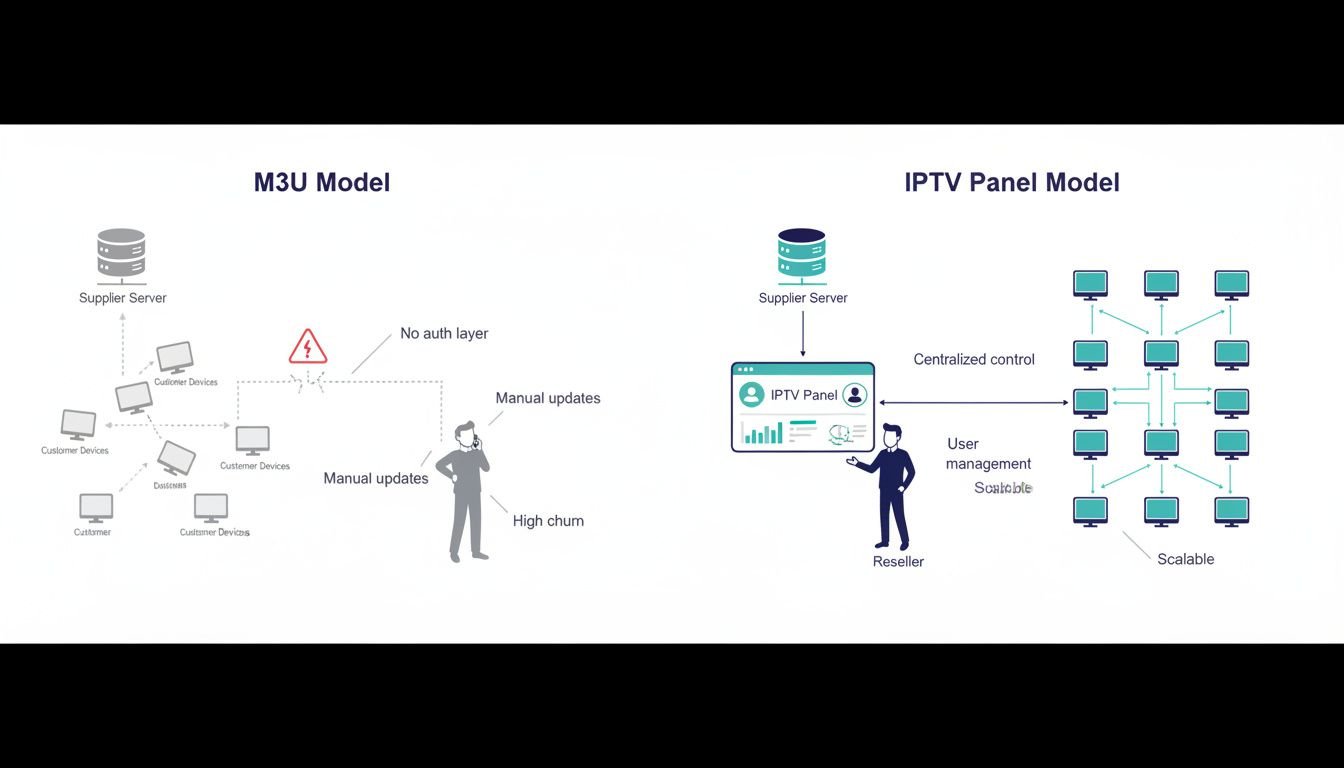
When people talk about M3U as a wholesale model, they are describing something specific: you buy access to a playlist file from a supplier, and you redistribute that file — or links derived from it — to your customers. Understanding how M3U playlist files are structured helps clarify why this creates operational problems at scale. An M3U file is essentially a text document containing a list of stream URLs. There is no authentication layer built into the format itself. The URL either works or it does not.
In practice, this means when you sell someone an M3U link, you are handing them a direct connection to your supplier’s infrastructure. You are not sitting between them and the stream in any meaningful way. If your supplier changes their URLs — which happens constantly, especially when they rotate servers to avoid detection — your customer’s player breaks and they message you at 11pm on a Saturday. You have no dashboard to push an update. You either send them a new file manually or automate that process yourself, which most new resellers are not equipped to do.
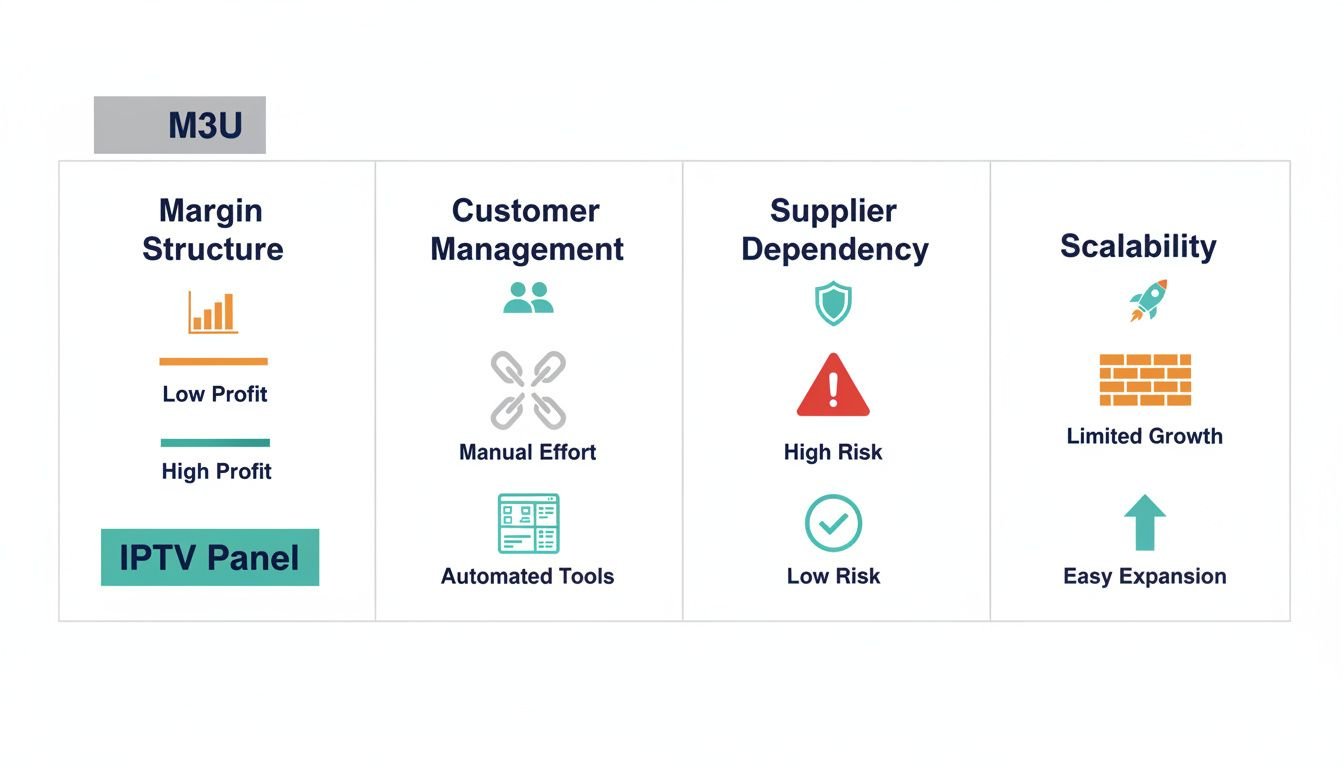
The margin structure with raw M3U is deceptively simple. Suppliers selling M3U access wholesale typically charge somewhere between $2 and $5 per connection per month at volume. You sell to your customer at $8 to $12. That spread looks fine until you factor in churn. Most new resellers set their price at $10 and hit 40% monthly churn before they understand why. The why is almost always instability — buffering, broken links, channels going down — combined with zero ability on your part to proactively manage the customer relationship through any kind of account system.
The Hidden Cost of No Account Control
With an M3U reseller setup, you do not create accounts. You do not set expiry dates in a system. You do not limit simultaneous connections through a dashboard. All of that either lives entirely with your upstream supplier or it does not exist. If a customer shares their link with three friends, your supplier’s system might throttle the connection, but you have no visibility into it and no way to enforce your own limits. You find out when your customer complains about buffering and you have no diagnostic tools to investigate.
This is why raw M3U distribution tends to work only in one specific situation: you are testing a new supplier’s stream quality before you commit to building a panel-based reseller operation on top of them. As a permanent business model for selling to end customers, it creates a ceiling you will hit fast.
How IPTV Reseller Panels Change the Business Structure
An IPTV reseller panel is a different arrangement entirely. You are not buying a file. You are buying credits or a reseller account on a supplier’s management platform, and through that platform you create individual customer accounts with their own login credentials, expiry dates, connection limits, and access tiers. The customer authenticates against the supplier’s server using their unique username and password, often through the Xtream Codes API, which is the protocol most modern IPTV apps use natively.
The operational difference is significant. When a customer’s subscription expires, the account stops working automatically — you do not have to chase them or manually revoke a file. When you want to suspend a non-paying customer, you click a button in your panel dashboard. When a customer calls with a buffering issue, you can check their connection logs, see how many streams they have active simultaneously, and identify whether the issue is on their end or the supplier’s infrastructure. That diagnostic capability alone reduces your support time by roughly half compared to managing M3U customers.
Panel-based reselling also gives you sub-reseller functionality on most platforms. Once you have enough volume, you can recruit your own sub-resellers, allocate them a block of credits, and let them manage their own customer bases while you collect the margin difference. That is how resellers with 500+ active customers structure their operations — they are not managing 500 individual accounts themselves. They have three or four sub-resellers underneath them each running 100 to 150 customers, and the panel infrastructure makes that possible without custom software development.
Credit Systems and How Margin Actually Works on a Panel
Most supplier panels operate on a credit system. You buy credits in bulk — say 100 credits for $150, which works out to $1.50 per credit. Creating a one-month customer account costs one credit. A three-month account costs three credits. You sell that one-month account to your customer for $10 to $15. Your gross margin per customer per month is roughly $8.50 to $13.50 before any support or payment processing costs.
The margin expands significantly when you buy larger credit blocks. A supplier might charge $1.50 per credit at 100 credits, $1.20 at 500 credits, and $0.90 at 1,000 credits. At 1,000 credits you are paying $900 for the block and generating $10,000 to $15,000 in customer revenue from it — assuming full utilization. That is where calculating your IPTV reseller profit margin becomes a real exercise rather than a back-of-envelope guess. The credit discount curve is the single biggest lever you have on profitability once your customer base stabilizes.
M3U vs IPTV Panel: Where Each Model Actually Wins
The M3U vs IPTV panel comparison is not a clean winner-takes-all situation. Each model has specific conditions where it makes operational sense, and being honest about those conditions saves you from building the wrong infrastructure for your customer base.
M3U distribution genuinely wins in two scenarios. First, when you are supplying to technically sophisticated customers who manage their own IPTV setups — think small hotel operators or tech-savvy cord-cutters who want to load a playlist into Jellyfin or Channels DVR. These customers do not need account management. They need a reliable stream URL and minimal handholding. Second, M3U works when you are operating a very small test operation to validate a supplier’s stream quality before committing to a panel relationship. Buying 10 M3U connections to test stability over two weeks is a legitimate due diligence step.
Panel-based reselling wins in almost every other scenario. If your customers are everyday consumers who need you to set up their device, answer questions about why a channel is missing, and renew their subscription reliably each month, you need the account management infrastructure a panel provides. The global IPTV market growth projections consistently point to consumer IPTV adoption expanding fastest in segments where end-user experience and reliability are the purchase drivers — not technical flexibility. That is the market most resellers are actually selling into.
Supplier Stability and What Happens When They Go Dark
Here is the scenario that separates resellers who survive from those who do not: your supplier disappears. No warning, no migration path, just a dead server and 80 customers texting you. This happens more often than most people in this industry will admit publicly. With raw M3U links, you have no customer database to speak of. You might have emails and payment records, but you have no account system to migrate. You are starting over.
With a panel-based operation, you have every customer’s account details, their subscription history, their contact information, and their usage patterns all in one place. You can export that, approach a new supplier, bulk-create accounts on their platform, and push the new credentials to your customers in a single communication. You lose a day or two of service and some customer goodwill. You do not lose the business. Learning how to choose a wholesale IPTV supplier includes evaluating exactly this kind of resilience — supplier longevity and panel data portability matter as much as stream quality.
Technical Setup Complexity: What You Are Actually Committing To
The technical lift between these two models is real and worth being direct about. Setting up an M3U reseller operation requires almost nothing on your end. You receive a URL or a file from your supplier, you share it with your customer, you tell them which app to use. If you are selling to 10 customers, you can manage this in a spreadsheet. It is not scalable, but it is fast to start.
Setting up a panel-based reseller operation requires more upfront investment in your own infrastructure — or at minimum, a serious orientation period with your supplier’s dashboard. You need to understand how their credit system works, how to create accounts with the correct package and connection limit settings, how to generate trial accounts for prospects, and how to handle renewals without over-billing or under-delivering. Most suppliers provide some documentation, but the quality varies wildly. Some give you a 20-page PDF that covers everything. Others give you a login and good luck.
Beyond the panel itself, you will likely need a customer-facing system: a way for customers to place orders, receive their credentials, and renew their subscriptions without you manually processing each transaction. That might be a simple WooCommerce store with a plugin that connects to your panel API, or it might be a purpose-built IPTV billing platform. Either way, there is setup work involved. The IPTV reseller technical setup guide covers this in detail, but the core point is that the panel model requires you to build a real operational layer — and that investment is what creates the moat that makes the business defensible.
Connection reliability is also a factor worth measuring, not assuming. Streaming industry connection reliability benchmarks show significant variance in uptime across service tiers, and panel-based suppliers who operate their own infrastructure tend to offer SLA commitments that M3U-only suppliers simply cannot match because the product is too loosely defined.
Payment Processing, Chargebacks, and the Business Risk Nobody Talks About
Both models expose you to the same payment processing reality: IPTV is a high-risk merchant category and mainstream payment processors will freeze your account when they figure out what you are selling. PayPal, Stripe, and Square have all been used successfully by IPTV resellers for varying periods of time, and all three have a history of freezing accounts in this space without much warning. This is not specific to M3U vs panel — it applies to both models equally.
Where the models diverge is in chargeback exposure. With raw M3U distribution, your customers have less visibility into what they are paying for. When a stream breaks and they cannot get a response from you quickly enough, the path of least resistance for them is a chargeback. With a panel-based system, customers have an account portal, a login they can check, and a clear record of what their subscription covers. That documentation reduces chargeback rates meaningfully — not to zero, but resellers who migrate from M3U to panel setups consistently report lower dispute rates.
Crypto payment acceptance has become standard among experienced resellers in both models, specifically because it eliminates the chargeback mechanism entirely and sidesteps processor risk. If you are serious about how to start an IPTV reseller business with any durability, building a crypto payment option in from the start is not paranoia — it is operational planning.
Which Model to Start With and When to Switch
If you are early in the process of figuring out this business, the right starting point depends on one question: do you already have a supplier relationship with a panel, or are you still evaluating suppliers? If you are still evaluating, start with M3U. Buy small test batches from multiple suppliers, run them for two to three weeks, document your uptime and channel consistency, and identify which supplier’s infrastructure is stable enough to build on. Checking the best M3U wholesale suppliers for resellers gives you a shortlist to start that evaluation with rather than going in blind.
Once you have identified a supplier worth committing to, switch to their panel program immediately. Do not try to scale an M3U reseller operation past 20 customers. The support burden becomes unmanageable, the churn compounds, and you will spend more time firefighting than selling. The panel model requires more setup but it is the only model that allows you to build something with real retention and real sub-reseller leverage.
The M3U vs IPTV panel question also matters when you are evaluating a new supplier mid-operation. A supplier who only offers M3U without any panel or account management system is signaling something about their operation. It might mean they are a small operation without the infrastructure investment to run a proper panel. It might mean they are aggregating streams from other sources and cannot offer account-level controls. Neither is necessarily disqualifying, but both are worth understanding before you migrate your customer base onto their infrastructure.
Scaling Past 100 Customers: What the Model Difference Looks Like at Volume
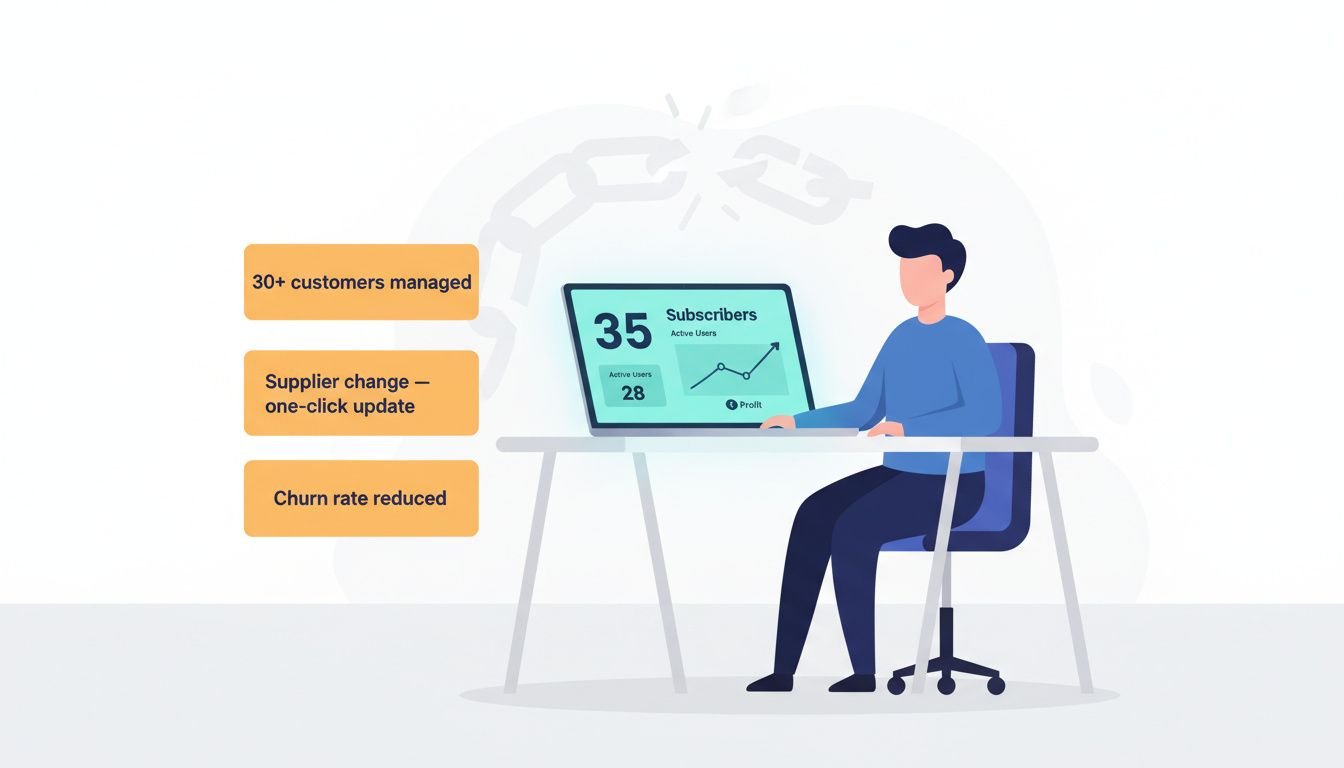
At 100 active customers, the operational gap between M3U reselling and panel-based reselling becomes impossible to ignore. A reseller managing 100 M3U customers is handling roughly 100 individual file or URL management relationships, manual renewal tracking, and a support queue that has no self-service component. That is a part-time job minimum, often more. The revenue at $10 per customer is $1,000 per month, which sounds reasonable until you account for the hours involved.
A reseller managing 100 customers through a panel dashboard has automated renewals through their billing system, a customer portal where subscribers can check their own account status, and connection logs they can reference when troubleshooting. The same $1,000 in monthly revenue requires a fraction of the active management time. That freed-up time is what you use to recruit the next 50 customers or the first sub-reseller.
Sub-reseller recruitment changes the math entirely. When you have a panel with available credits and a working customer acquisition process, you can approach someone in your network who wants to sell IPTV and give them a reseller account under yours. They buy credits from you at a markup over your supplier cost, manage their own customers, and handle their own support. You are collecting margin on their volume without adding to your own support burden. This is how IPTV resellers who are doing real revenue structure their operations — not by personally managing 500 customers, but by running a small network of sub-resellers each managing 100 to 150.
That structure is only possible with a panel. M3U distribution has no sub-reseller layer. You can technically tell someone to resell links they get from you, but there is no account management infrastructure underneath it and no way to enforce credit limits or track utilization. It collapses under its own complexity before it scales. If building toward that kind of volume is part of your plan, the M3U vs IPTV panel decision is already made for you — panels are the only model that gets you there.
Frequently Asked Questions
What is the difference between M3U and an IPTV reseller panel?
An M3U playlist is a static file or URL containing channel links you share directly with customers. An IPTV reseller panel is a dashboard that lets you create and manage customer accounts, set expiry dates, monitor connections, and control access — giving you far more operational control over your business.
Which wholesale IPTV model is easier to start with as a beginner?
M3U is easier to start with because there is nothing to configure — you receive a URL and pass it to your customer. However, it offers no management tools. A reseller panel has a steeper setup curve but gives you the infrastructure to run a real business, making it the better long-term starting point even for beginners.
Can I resell IPTV using just an M3U link?
Yes, but with serious limitations. You cannot create individual customer accounts, control expiry, limit simultaneous connections, or track usage. You are essentially sharing one link with multiple people, which creates support headaches and makes it nearly impossible to scale or retain customers professionally.
What is an Xtream Codes panel and how does it relate to IPTV reselling?
Xtream Codes is the most widely used API standard for IPTV reseller panels. It lets you generate unique login credentials per customer, manage subscriptions, and monitor streams. Most wholesale IPTV suppliers offer reseller access through an Xtream Codes-compatible panel, making it the de facto infrastructure for professional resellers.
Which wholesale IPTV model has better profit margins — M3U or panel?
IPTV reseller panels typically support better margins because you buy credits in bulk at wholesale rates and set your own retail price per account. M3U reselling offers little pricing flexibility since you are redistributing a single feed. Panel-based reselling also reduces churn through better customer management, which directly improves long-term profitability.