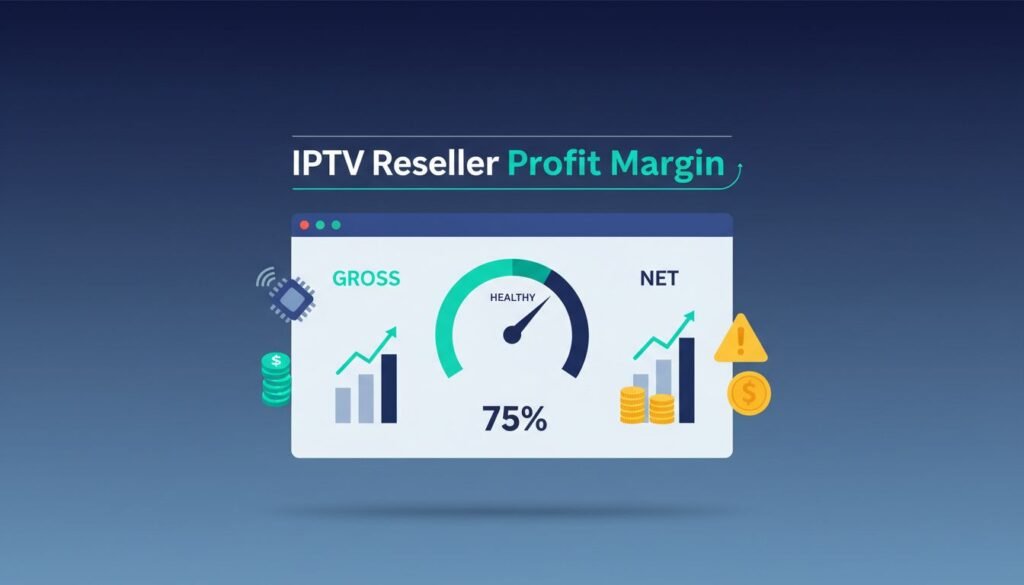
Most new resellers quote an IPTV reseller profit margin somewhere between 100 and 300 percent and feel good about it. Then three months in, a payment processor freezes their account for two weeks, a supplier goes dark with 40 credits still unused, and they refund six customers in a single weekend. The math that looked clean on a napkin starts bleeding from a dozen small cuts they never counted. The headline number — buy at $1.85 per credit, sell at $15 per month — is real.
The problem is that gross margin and net margin are two completely different figures in this business, and almost nobody in the space explains how to calculate the gap between them. If you are running a reseller operation and you have never sat down to work through the full formula, you are almost certainly pricing too low, absorbing costs you have not named, and leaving the business more fragile than it needs to be.
The Gross Margin Formula Every IPTV Reseller Should Know First
Gross margin is the starting point, not the finish line. Before you can understand what your operation actually earns, you need to know what you earn before overhead. The formula is straightforward:
Gross Margin % = ((Selling Price – Cost of Credits) / Selling Price) x 100
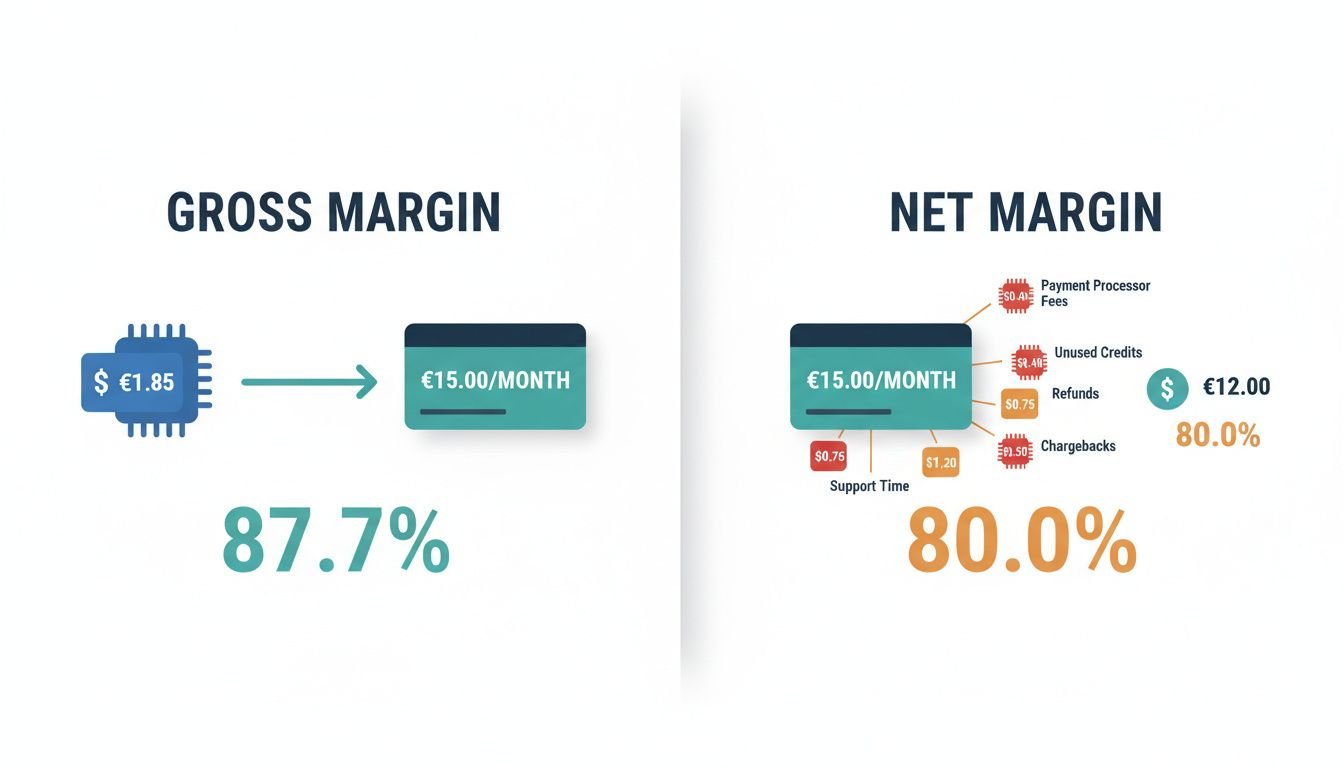
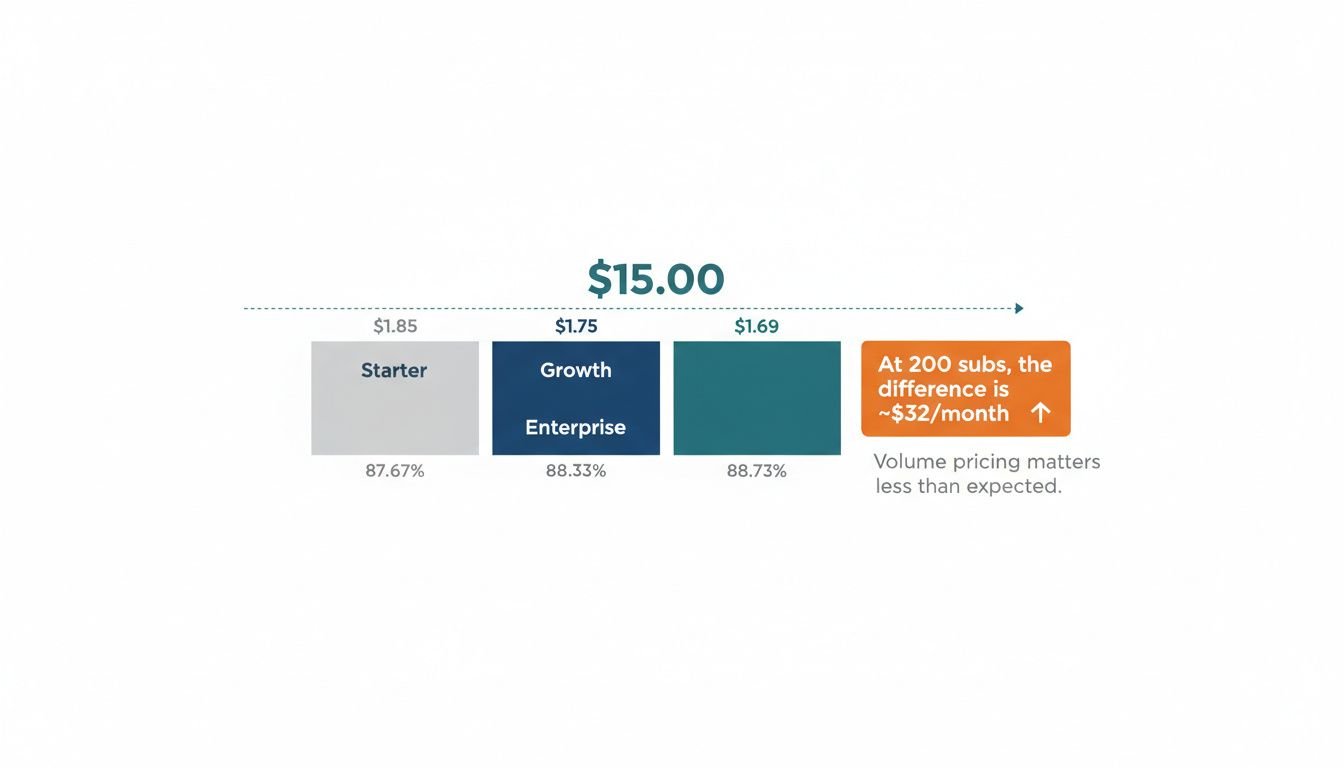
Take a concrete example. You are buying credits at $1.85 each on a starter tier from your wholesale supplier. One credit equals one month of one subscription. You sell monthly plans at $15. Your gross margin on that single transaction is (($15 – $1.85) / $15) x 100, which gives you 87.7 percent. That sounds excellent. And at the gross level, it is.
Now scale it slightly. You move to enterprise tier and your cost drops to $1.69 per credit. Same $15 selling price. Gross margin moves to 88.7 percent. The difference per customer is $0.16 — which is nearly nothing at 20 subscribers, but adds up to roughly $32 per month at 200 subscribers. Volume pricing matters, but it matters less than most resellers expect when they first discover it.
The more important variable at this stage is your sell price, not your buy price. A reseller selling at $12 per month with $1.85 credit costs is running a gross margin of 84.6 percent. A reseller selling at $20 is running 90.75 percent. That eight-dollar difference in sell price creates a six-point margin gap before a single overhead cost is counted. This is why understanding how to price your IPTV reseller service is not a secondary concern — it is the primary lever on your gross margin.
One thing worth separating out here: if you sell quarterly or annual plans, your credit cost per month stays the same, but your cash flow changes dramatically. A $40 quarterly plan means you collect $40 upfront but spend 3 credits ($5.55 at $1.85 per credit) immediately. Gross margin on that transaction is (($40 – $5.55) / $40) x 100 = 86.1 percent. Slightly lower than the monthly equivalent because of how the math rounds, but the cash position is better because you have the full $40 in hand now.
Why Multi-Month Pricing Changes Your Margin Calculation
The standard retail price points you will see quoted across the industry sit at roughly $15 per month, $40 per quarter, $75 for six months, and $130 per year. If you run the gross margin formula on each of these using a $1.85 credit cost, you get: monthly at 87.7 percent, quarterly at 86.1 percent, six-month at 85.0 percent, and annual at 82.9 percent.
Gross margin actually compresses slightly as plan length increases, even though the total revenue per customer goes up. The reason is that you are buying more credits upfront against a fixed sell price. You are trading margin percentage for volume and retention. Whether that trade is worth it depends entirely on your churn rate — which is the bridge to net margin.
Calculating Net IPTV Reseller Profit Margin After Real Costs
This is where the business either works or does not. Net margin is what you keep after every cost that touches the transaction. Most guides skip this entirely or mention it in passing. Here is the full cost stack you need to account for:
- Payment processing fees: Typically 2.9 percent plus $0.30 per transaction for standard card processing. On a $15 sale, that is $0.74 — or about 4.9 percent of revenue gone immediately. If you are using high-risk processors because standard ones have declined your account, fees often run 4.5 to 6 percent plus per-transaction fees. Understanding how payment processing fees affect subscription business margins is critical if you are scaling past 50 active subscribers.
- Refunds and chargebacks: Budget 3 to 5 percent of revenue for this. A chargeback does not just cost you the sale — it costs you the processing fee you already paid, and if your chargeback ratio climbs above 1 percent, you risk losing your processor entirely.
- Panel or reseller tools: Some suppliers include a panel in the credit price. Others charge separately. If you are paying $10 to $30 per month for panel access, that cost needs to be divided across your active subscriber count.
- Support time: This one is invisible in most calculations but very real. If you spend four hours per week on customer support and you value your time at even $15 per hour, that is $240 per month in opportunity cost. At 50 subscribers paying $15, your total monthly revenue is $750. That support cost is 32 percent of revenue.
The net margin formula becomes:
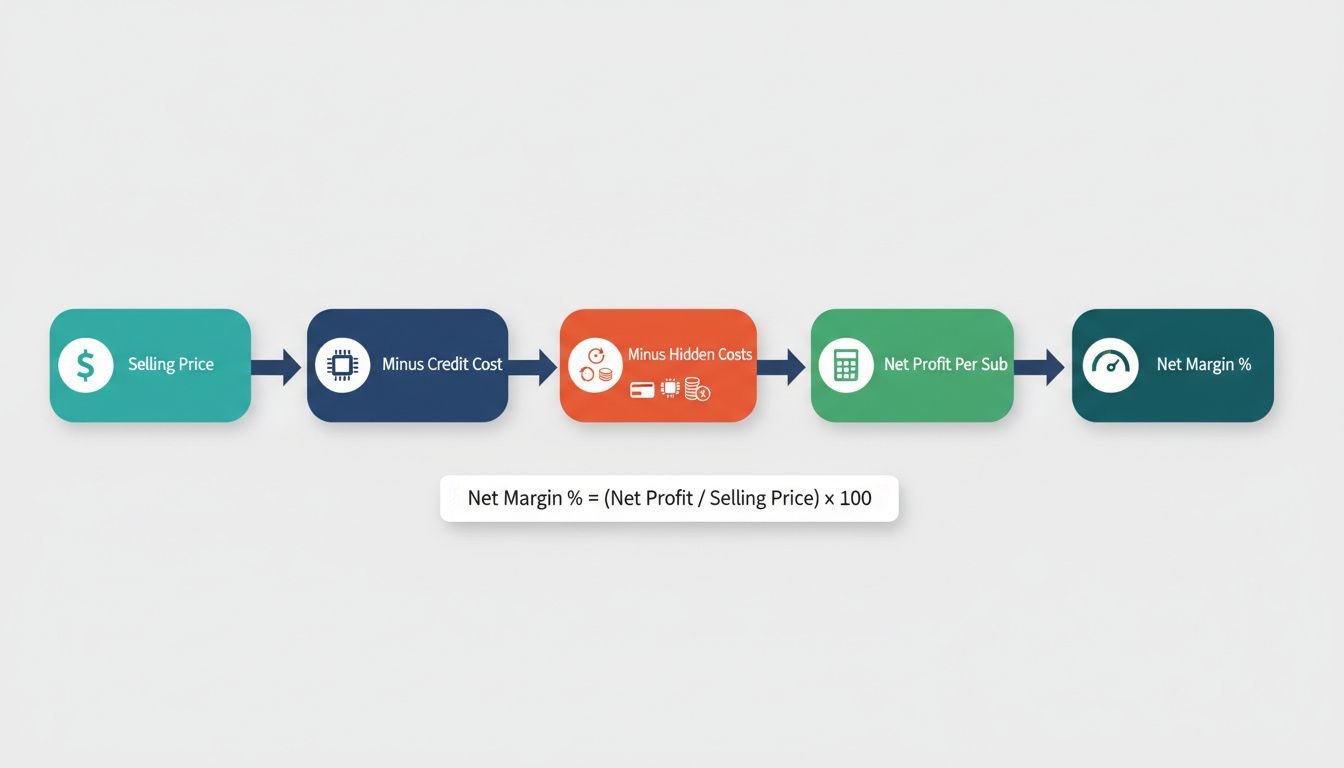
Net Margin % = ((Revenue – Credit Costs – Processing Fees – Refunds – Tools – Support Value) / Revenue) x 100
Run it on a realistic small operation: 50 subscribers at $15 per month. Revenue: $750. Credit costs: $92.50. Processing fees: $37 (at 4.9 percent average). Refunds: $22.50 (3 percent). Panel tools: $15. Support time value: $120 (two hours per week at $15/hour). Net profit: $750 – $92.50 – $37 – $22.50 – $15 – $120 = $463. Net margin: 61.7 percent. That is a long way from the 87.7 percent gross margin you started with.
That $463 figure is actually close to the ground-level benchmark from real resellers in the space — one operator on Reddit reported $300 to $500 net per month for three to four hours of work per week at small scale. The math checks out. It is not a bad result for part-time work, but it is not the $10,000 to $15,000 per month figure you see in aspirational content either.
What Churn Does to Your Net IPTV Reseller Profit Margin
Churn is the single most destructive force on IPTV reseller profit margin, and it is almost never modeled in the guides that claim 100 to 300 percent returns. Most new resellers set their price at $10 and hit 40 percent monthly churn before they understand why. Even at $15 with decent service, monthly churn in the IPTV space often runs 15 to 25 percent without active retention effort. According to subscriber churn rate benchmarks for subscription services, even well-run subscription businesses target churn below 5 percent monthly. IPTV resellers frequently operate at three to five times that rate.
What does 20 percent monthly churn actually mean for your margin? If you start January with 50 subscribers and add 10 new ones per month but lose 20 percent, by month three you have roughly 52 subscribers — you are barely growing despite consistent acquisition effort. More importantly, every churned subscriber represents a customer you paid acquisition costs to bring in, credits you may have already loaded, and a refund you might owe. The effective cost per retained subscriber is much higher than the raw credit cost suggests. If you want to model this properly, the free IPTV reseller profit calculator on this site lets you input your churn rate and see how it compounds against your margin over time.
Where IPTV Reseller Profit Margin Benchmarks Actually Sit by Scale
Let’s be concrete about what different scale levels look like in this business, because the margin profile changes significantly as you grow.
At the small scale — 20 to 50 subscribers — your net margin is often 55 to 65 percent if you are priced correctly and your churn is manageable. Support time dominates your cost structure because you cannot spread it across enough subscribers. You are essentially trading time for money at this stage, and the hourly rate is decent but not exceptional.
At mid-scale — 100 to 300 subscribers — the economics start to shift in your favor. Your panel tools cost the same $15 to $30 per month whether you have 100 or 300 subscribers. Support time does increase, but not linearly — a well-structured FAQ, a decent Telegram group, and a clear onboarding process can keep support time nearly flat from 100 to 200 subscribers. Net margins at this scale can reach 65 to 75 percent if pricing is right and churn is below 15 percent monthly.
At scale — 500 or more subscribers — the math gets interesting in both directions. You are likely qualifying for lower credit tiers, which helps gross margin. But you are also dealing with more chargebacks, more payment processor scrutiny, and potentially more supplier reliability issues. If a supplier goes dark and you have 500 active subscribers, you are looking at a mass refund event that can wipe out two to three months of net profit in a single week. This is why choosing a wholesale IPTV supplier with genuine redundancy and a track record is not optional at that scale — it is a margin protection decision.
The resellers who report $10,000 to $15,000 per month in revenue are typically operating at 400 to 600 subscribers at $25 to $35 per month price points, often with multiple plan tiers and some annual subscribers providing cash flow stability. Their gross margin is high, but their net margin after all real costs is probably closer to 60 to 70 percent — meaning actual take-home of $6,000 to $10,500 per month before tax. Still excellent. But built on pricing discipline and churn management, not on the credit cost differential alone.
The Costs That Quietly Destroy IPTV Reseller Profit Margin Over Time
There is a category of costs that does not show up in any single transaction but erodes your annual margin in ways that are hard to see unless you are tracking them. These are the costs that experienced resellers account for and beginners discover the hard way.
Stranded credits are the most common. You buy a block of 100 credits to hit a better tier price. A supplier goes dark, or you have a bad month and subscribers churn faster than expected. You are now sitting on 40 credits you cannot use with that supplier and may not be able to transfer. That is $74 in inventory that just became a loss. It does not show up as a transaction cost, but it absolutely hits your annual net margin.
Promotional offers compound this problem. If you offer a free first month to acquire customers, you are spending one credit — $1.85 — per acquisition with no revenue on that first month. If your churn is 25 percent, one in four of those customers never pays you anything. Your effective credit cost on paying customers who came in via free trial is higher than your nominal credit cost, and most resellers never calculate it.
Payment processor account freezes are another silent margin killer. If your processor holds funds for two to four weeks — which happens regularly in this space — you have credit costs going out while revenue is frozen. You may need to buy credits on a credit card during that period, adding interest costs. And if you lose a processor entirely and need to migrate, you will lose some subscribers in the transition who simply do not bother to re-subscribe with new payment details. Account migration churn is real and can hit 10 to 20 percent of your subscriber base in a single event.
If you are thinking about building a more resilient operation from the ground up, reviewing how to start an IPTV reseller business with these margin realities in mind — rather than the headline percentage claims — will save you significant money in the first six months.
Setting a Target IPTV Reseller Profit Margin and Pricing Backward From It
Once you understand the full cost stack, you can stop guessing at your sell price and start engineering it. This is the approach that separates operators who build stable income from those who grind through high volume at thin margins and burn out.
Start by defining your target net margin. A reasonable target for a well-run reseller operation is 60 to 70 percent net margin. Below 50 percent, you are working too hard for the return. Above 75 percent, you are either underestimating your costs or you have built something genuinely exceptional in terms of retention.
Then work the formula backward. If you want a 65 percent net margin and your total non-credit costs per subscriber per month are approximately $3.50 (processing, tools allocation, support allocation, refund reserve), and your credit cost is $1.85, your total cost per subscriber is $5.35. For a 65 percent net margin, your sell price needs to satisfy: Sell Price x 0.35 = $5.35, which means Sell Price = $15.28. So $15 per month is the absolute floor for this cost structure at a 65 percent net margin target. Price at $10 and your net margin collapses to around 46 percent — you are working for significantly less than you should be.
Price at $18 and your net margin climbs to approximately 70.3 percent. Price at $20 and you hit 73.3 percent. The difference between a $15 and a $20 price point, at 100 subscribers, is $500 per month in additional net profit. And in most markets, $20 per month for a reliable IPTV service is not a hard sell — it is cheaper than a single streaming platform.
Understanding the difference between M3U-based and panel-based wholesale models also affects this calculation, because the cost structure and flexibility differ meaningfully. The M3U vs IPTV panel wholesale models compared breakdown covers how each model affects your per-subscriber cost basis and therefore your achievable margin.
The resellers who sustain this business over years are not the ones who found the cheapest credits. They are the ones who priced correctly from the start, tracked every cost category, and treated margin protection as an ongoing operational discipline rather than a one-time calculation.
Frequently Asked Questions
What is a good profit margin for an IPTV reseller?
A realistic net margin after costs is 40 to 60 percent for most small resellers. Headline figures of 100 to 300 percent refer to markup, not true margin. Once you subtract payment processing fees, support time, refunds, churn, and tools, actual margins are significantly lower than wholesale-to-retail price comparisons suggest.
How do you calculate IPTV reseller profit margin?
Use this formula: Net Profit = (Retail Price x Active Subscribers) minus (Wholesale Cost + Payment Fees + Refunds + Tool Costs + Support Time Value). Divide net profit by total revenue and multiply by 100 to get your margin percentage. Always calculate on active subscribers, not total credits purchased.
How much can a beginner IPTV reseller realistically earn per month?
Ground-level data from active resellers suggests $300 to $500 net profit per month is a realistic starting point, working three to four hours per week. Scaling to $2,000 or more per month typically requires 80 to 150 active subscribers and a structured pricing and retention strategy.
What costs eat into IPTV reseller margins most?
The biggest margin killers are churn (subscribers who cancel before renewal), unused credits you pre-purchased, payment processor fees of 2 to 4 percent, refund requests, and the hidden cost of support time. Resellers who ignore these often overestimate profitability by 20 to 40 percent.
Does buying more wholesale IPTV credits improve profit margin?
Only if your subscriber base is large enough to use them. Higher-tier credit pricing can drop per-unit cost from around $1.85 to $1.69, improving margin by a few percentage points. But pre-buying credits you cannot sell converts potential profit into sunk cost, which hurts overall margin.