Most new resellers buy their first credit package, stare at a wholesale cost of somewhere between $2.50 and $6 per line, and then do one of two things: they either price at $10 because it feels round and competitive, or they copy whatever number they saw on someone else’s Telegram channel. Neither approach is a strategy. IPTV reseller pricing done properly is a decision that touches your churn rate, your customer lifetime value, your ability to survive a wholesale price hike, and whether you actually make money at volume or just stay busy.
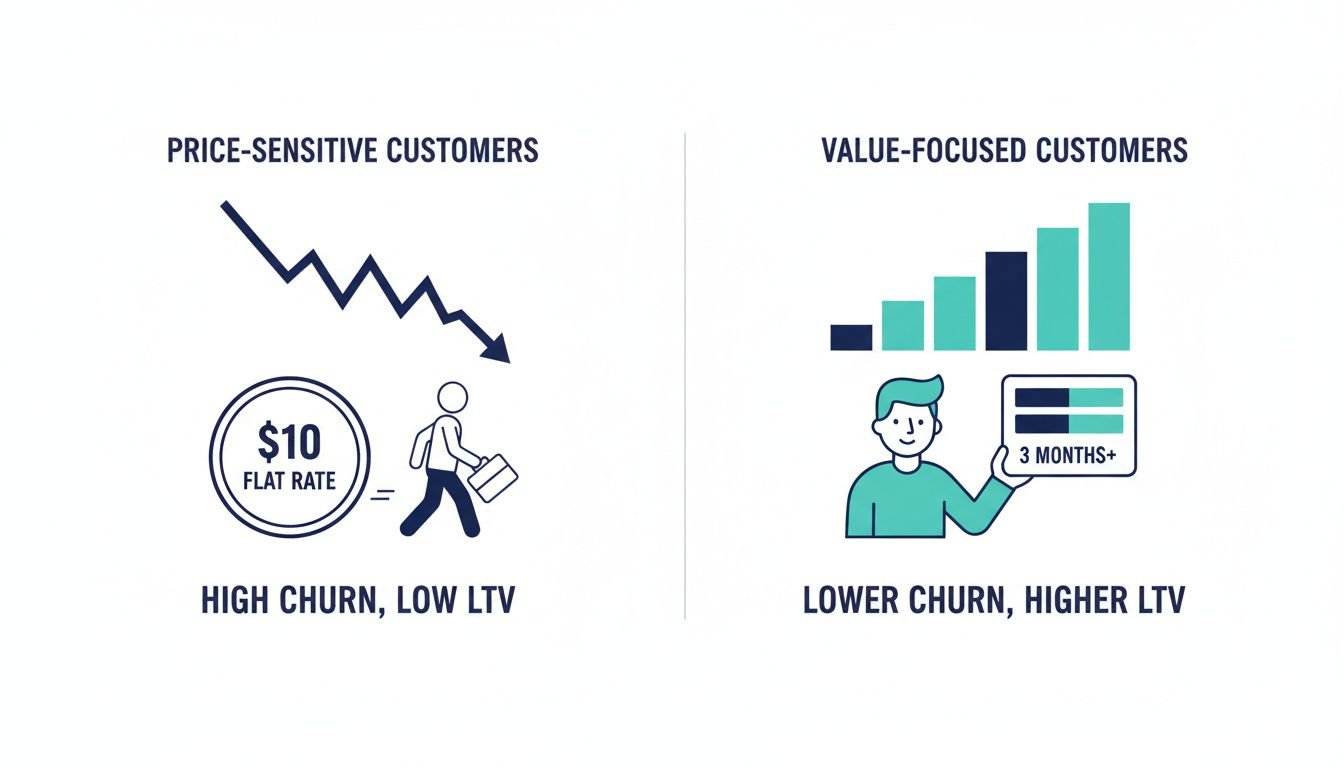
Most new resellers set their price at $10 and hit 40% monthly churn before they understand why. The price was not the only cause, but it attracted the most price-sensitive customers in the market, and price-sensitive customers leave the moment a cheaper option appears. This article is about building a pricing structure that holds up under real conditions — not theoretical margins on paper, but actual recurring revenue from customers who stay.
What Your Wholesale Cost Actually Tells You (And What It Does Not)
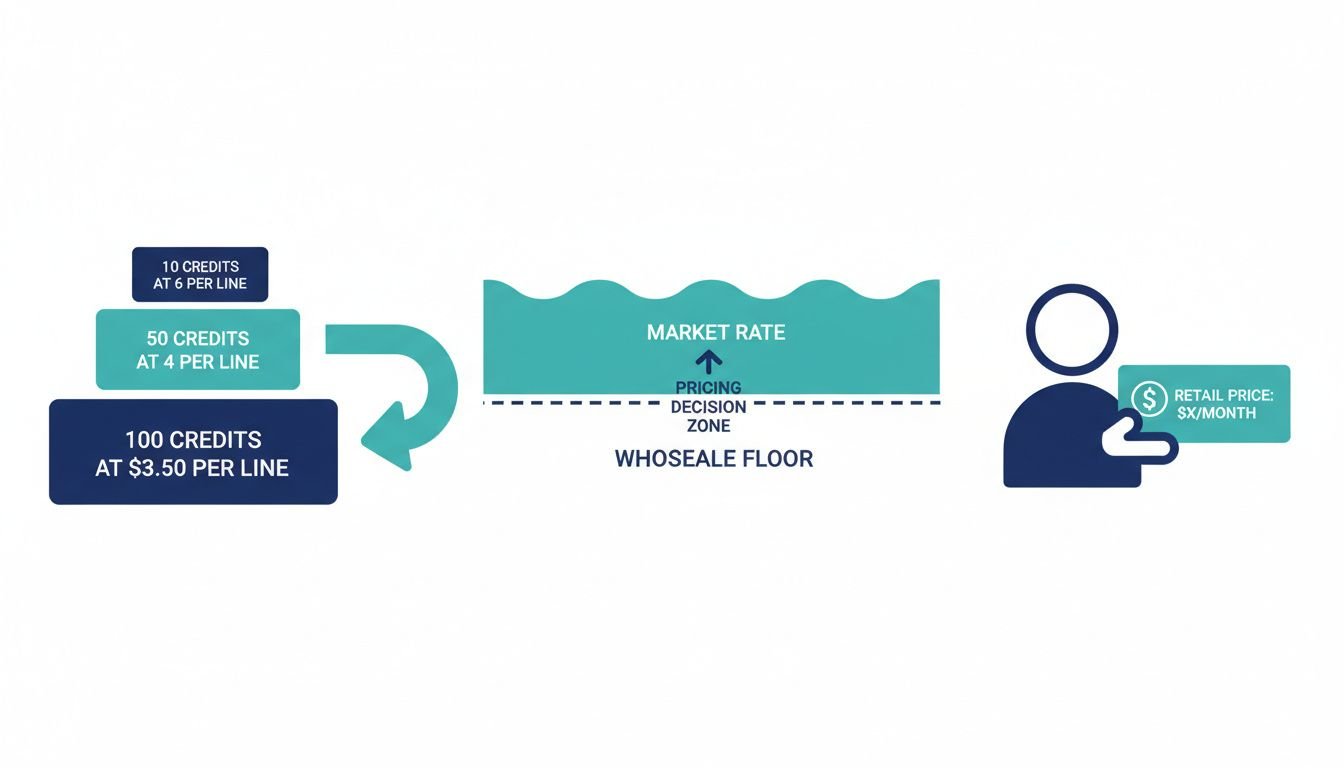
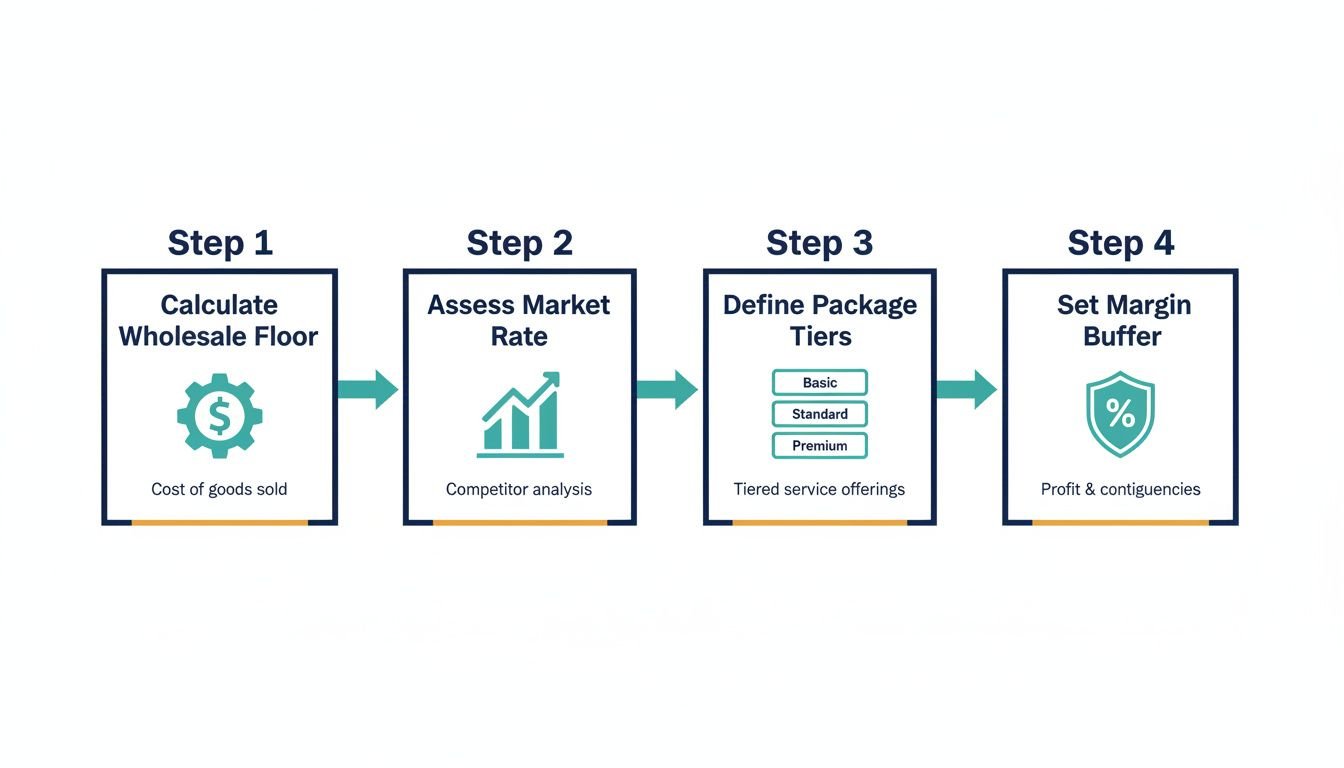
Your wholesale cost per credit is your floor. That is all it is. It tells you the minimum you cannot go below without losing money on the subscription itself. It does not tell you what customers will pay, what the market will bear, or what price point minimises churn. Treating it as the foundation of your pricing decision is correct. Treating it as the primary driver is where most resellers go wrong.
A typical wholesale credit from a mid-tier panel provider runs $3 to $5 per line per month when you buy in bulk. At the entry level — 10 credits for around $55 to $60 — you are paying roughly $5.50 to $6 per line. Buy 50 credits and that number drops to $4 or lower.
Buy 100 and you can get under $3.50 with the right supplier. That cost compression at volume is real, but it only helps you if you have the customers to burn through credits before they expire. Sitting on 50 unused credits at month end is not a volume discount. It is a sunk cost.
Before you set a single retail price, you need to know your actual blended cost per active subscription. That means accounting for credits that expire unused, credits you issue as trials or refunds, and any panel or reseller platform fees on top of the credit cost.
If you are losing 10% of your credits to trials and no-converts, your effective cost per paying subscriber is higher than your wholesale rate suggests. Use that adjusted number as your floor, not the headline wholesale price.
To get a precise figure on what you are actually making at different price points, calculate your exact IPTV reseller profit margin before you commit to any retail price. The numbers will surprise you once you factor in real-world credit wastage. For a broader view of how margin works for digital subscription businesses, understanding gross margin for digital service businesses gives you the framework to apply to your own numbers.
Single-Connection vs. Multi-Connection Pricing
One thing almost no pricing guide covers is that a multi-connection plan and a single-connection plan are not the same product. Most wholesale panels offer up to 5 simultaneous connections per subscription, but many resellers sell every plan as a single-connection offering and leave real margin on the table. A customer running 2 or 3 connections in a household is getting significantly more value from one subscription than a solo viewer is. Price accordingly.
A reasonable structure is to charge a base price for 1 connection, then add $2 to $4 per additional connection. A 1-connection monthly plan at $12 becomes a 2-connection plan at $15 and a 3-connection plan at $18. Your wholesale cost for all three is identical — one credit.
The margin on the 3-connection plan is roughly 50% higher than on the single-connection plan, with zero additional cost to you. Most customers in a family household will take the 2 or 3-connection option without hesitation because it still undercuts what they were paying for a cable bundle.
Building a Tiered Package Structure That Protects Margin at Every Level
The most common mistake in IPTV reseller pricing is treating it as a single number problem. You are not setting one price. You are building a menu, and the architecture of that menu determines your average revenue per user more than any individual price point does.
A proper tiered structure covers 1-month, 3-month, 6-month, and 12-month commitments. Each tier needs to do two things simultaneously: it needs to look like better value than the tier below it, and it needs to preserve your margin in absolute dollar terms, not just percentage terms. This is where most resellers miscalculate. They offer a 12-month plan at a steep per-month discount and end up collecting less total gross profit from a 12-month customer than from two 6-month renewals.
Here is a structure that works. If your monthly price is $15, your 3-month should come out to roughly $12 to $13 per month effective (total $36 to $39), your 6-month at $11 to $12 effective (total $66 to $72), and your 12-month at $10 to $11 effective (total $120 to $132).
At a wholesale cost of $4 per credit, your gross profit on a 12-month plan paid upfront is $80 to $92. Your gross profit on 12 individual monthly renewals at $15 is $132 — but only if that customer renews every single month without lapsing. The annual plan trades margin per dollar for certa inty of payment and zero churn risk on that customer for the year. That trade is usually worth making.
Anchoring the Annual Plan Against the Monthly Price
The way you present your tiers matters as much as the numbers themselves. How subscription pricing psychology affects consumer decisions is well-documented: customers anchor to the first number they see and evaluate everything else relative to it. Put your monthly price front and centre, then show the annual plan as “equivalent to $10.83 per month — save $49 per year.” You are not discounting. You are reframing the same price as a saving against a reference point you just set.
Most customers in the IPTV space are already comparing your price to their old cable bill, which might have been $80 to $120 per month. Your monthly price of $15 already looks cheap by that comparison. The annual plan at $120 to $130 upfront looks like a single month of their old cable bill. That framing closes annual sales faster than any feature comparison will.
Market Positioning: Volume, Mid-Market, or Premium
Where you sit in the market is a strategic choice, not a default. There are three viable positions for an IPTV reseller and each one has a different customer profile, a different churn dynamic, and a different operational load.
The low-end volume play means pricing at $8 to $10 per month and competing on price alone. This works if you have a high-volume acquisition channel — a large Telegram group, a Reddit presence, or an affiliate network sending you traffic. The problem is that customers at this price point have the highest churn. They came to you because you were cheap.
They will leave for the same reason. You need to be continuously acquiring new customers just to maintain your subscriber count, which means your customer acquisition cost eats into the thin margin you thought you were protecting. The global streaming market size and growth projections show growing consumer willingness to pay for streaming services, which means the low-end race to the bottom is a choice, not a necessity.
The mid-market position — $12 to $18 per month — is where most sustainable reseller operations live. The price is still dramatically below cable but high enough that you are not attracting purely price-driven customers. At this level, a decent panel, reliable uptime, and basic customer service create enough stickiness that monthly churn drops to 15% to 20% for a well-run operation. That is still high by software subscription standards, but it is manageable when your margin per subscriber is $8 to $12 net.
The premium position — $20 to $30 per month — requires genuine differentiation. That means fast setup support, a dedicated customer-facing contact method, possibly a custom app or branded portal, and proactive communication when there are service issues. The customers willing to pay premium prices exist, but they are buying the service experience as much as the content. If your panel goes down for 4 hours on a Saturday night and you are unreachable, a premium customer does not renew. A $10 customer shrugs and waits.
Geographic Pricing Benchmarks Worth Knowing
The competitive benchmark for IPTV pricing varies by market in ways that matter if you are targeting a specific region. UK resellers operate in a market where awareness of IPTV as an alternative to Sky and Virgin is relatively high, and where customers are accustomed to paying £20 to £50 per month for traditional pay-TV. UK resellers commonly price between £10 and £15 per month for a standard plan, which represents strong value against the alternative and supports healthy margins even after currency conversion on wholesale costs paid in USD.
US resellers face a more fragmented competitive landscape because the streaming market is more saturated. Customers who have already cut cable are often juggling Netflix, Hulu, and Disney Plus, and they are more likely to evaluate your IPTV service as an addition to that stack rather than a replacement for everything. Canadian resellers sit somewhere between these two dynamics, with strong awareness of IPTV and a customer base that responds well to the sports content angle given the importance of hockey and regional sports networks in the market.
Understanding IPTV Reseller Pricing When Your Supplier Raises Costs
Every reseller eventually faces a wholesale price increase. A provider that was selling credits at $3.50 moves to $4.50. Or they restructure their credit system so that the credits you used to buy for $55 per 10 now cost $70. This is not rare. It is routine. How you handle it determines whether your business survives it or whether you scramble to find a new supplier while your customers notice the instability.
The first rule is to never build your retail price so close to your wholesale cost that a $1 increase wipes out your margin. If you are selling at $10 and your wholesale cost moves from $4 to $5, you just lost 16% of your gross margin overnight.
If you are selling at $15 and the same increase happens, you lost 10% of your gross margin and still have $10 per subscription to work with. The buffer matters. Price with the assumption that your wholesale cost will increase by 20% to 30% at some point in the next 12 months. If it does not, the extra margin is yours. If it does, you are not forced into an emergency price increase to your customers.
When a price increase does hit and you need to pass it on, the way to do it without mass churn is to grandfather existing customers for 60 to 90 days while applying the new price to all new signups. This gives existing customers time to accept the change as inevitable rather than experiencing it as a sudden betrayal.
Announce it directly, explain it briefly — “our wholesale costs have increased and we are adjusting prices from [date]” — and offer existing customers the option to lock in an annual plan at the current rate before the change takes effect. You will convert a meaningful percentage of monthly customers to annual plans in that window, which both reduces your churn risk and gives you upfront cash to cover the higher wholesale costs.
Choosing a supplier with pricing stability and transparent credit structures reduces how often you face this problem. If you have not yet locked in a supplier or you are evaluating alternatives, the guide on how to choose a wholesale IPTV supplier covers what to look for in terms of pricing structure and contract terms.
Churn Rate, Lifetime Value, and Why the Per-Subscription Margin Is the Wrong Number to Optimise
The per-subscription margin is the number every new reseller fixates on. It is also the wrong number to optimise. What actually determines whether your reseller operation is profitable is customer lifetime value — how much gross profit a single customer generates from their first payment to the day they cancel.
A customer paying $10 per month with a 30% monthly churn rate has an average lifetime of about 3.3 months. At a wholesale cost of $4, you make $6 per month gross, so that customer is worth about $20 in total gross profit. A customer paying $15 per month with a 15% monthly churn rate has an average lifetime of about 6.7 months. At the same wholesale cost, you make $11 per month gross, and that customer is worth about $73 in total gross profit. The $15 customer is worth 3.6 times more than the $10 customer, even though the price difference is only 50%. The churn rate difference is doing most of the work.
This is the core argument against competing on price. Lower prices attract customers with weaker retention. Higher prices, combined with reasonable service quality, attract customers who stay long enough to actually be valuable. The math on this is not subtle. It is the single most important relationship in IPTV reseller pricing, and almost no one talks about it explicitly.
Retention is partly about price and partly about product quality. If your panel has consistent uptime issues, no price point will retain customers. Get the technical fundamentals right first — the complete IPTV reseller technical setup guide covers the infrastructure decisions that directly affect the service reliability your customers experience. Once the product is stable, your pricing strategy can actually do its job.
Structuring Your Offer: What to Put on the Page and How to Present It
Pricing architecture is not just about the numbers. It is about how those numbers are presented, how many options you show, and what each option signals to a prospective customer. Most resellers present too many options or present them in a way that makes comparison difficult. Both mistakes reduce conversion.
Three to four tiers is the right range for most reseller storefronts. Fewer than three and you are not giving customers a real choice. More than four and you trigger decision paralysis, particularly with customers who are already slightly uncertain about buying from an independent reseller rather than a mainstream streaming service. Your tiers should differ on commitment length, not on content or features — unless you are genuinely offering different content packages at the wholesale level, which most panel-based resellers are not.
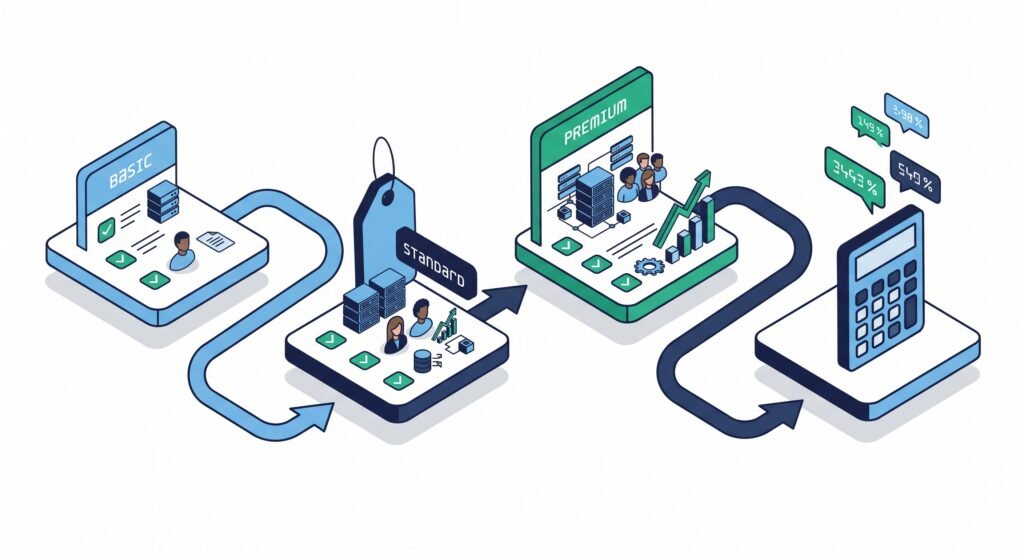
Name your tiers based on duration, not quality language. “Basic,” “Standard,” and “Premium” imply quality differences that do not exist when all tiers access the same channel list. “1-Month,” “6-Month,” and “12-Month” are honest and make the value comparison obvious. Customers can do the math themselves, and when they do, the annual plan wins on a per-month basis, which is exactly the conclusion you want them to reach.
Include a single-connection and a multi-connection variant for at least your 1-month tier, since this is where most new customers start. Let them choose 1, 2, or 3 connections upfront rather than requiring an upgrade later. An upgrade request means a support interaction, which has a cost. Capturing the right connection count at signup is cleaner for you and better for the customer.
On payment methods: the options you offer affect who can buy from you and how much friction exists at checkout. The IPTV market runs heavily on crypto, PayPal friends and family, and cash apps precisely because traditional card processors frequently close accounts in this space. Think carefully about which payment options you advertise publicly versus handle privately, and make sure the options you offer match the risk tolerance of your payment processors. For acquisition strategy that accounts for how customers find you and what they expect at checkout, the guide on how to find IPTV customers across 8 real channels is worth reading alongside your pricing work.
Finally, understand the difference between the M3U and panel delivery models before you finalise your pricing, because the model affects your operational costs and what you can reasonably charge for. M3U vs IPTV panel wholesale models compared breaks down the cost and operational differences between the two approaches in enough detail to inform your pricing structure rather than just your technical setup.
Frequently Asked Questions
How much should I charge for my IPTV reseller service?
Most resellers charge between $10 and $25 per month for a single connection. Your floor is your wholesale credit cost, typically $2.50 to $6. From there, factor in support time, churn risk, and your local market. Pricing below $10 rarely leaves enough margin to sustain the business after refunds and customer service overhead.
What is a good profit margin for an IPTV reseller?
A healthy target is 60 to 75 percent gross margin. If you pay $4 per credit wholesale, selling at $12 gives you a 67 percent margin. Margins below 50 percent leave little room for refunds, downtime credits, or marketing spend. Margins above 80 percent are achievable but usually require premium positioning with added support.
How do I structure IPTV reseller packages by duration?
Offer 1-month, 3-month, 6-month, and 12-month tiers. Discount each longer tier by 10 to 15 percent relative to the monthly rate, but never below your cost floor. A 12-month plan improves cash flow and reduces churn, so a modest discount is worth it. Avoid discounting so aggressively that a single refund wipes the margin.
Should I charge more for multi-connection IPTV plans?
Yes. A two-connection plan should not simply double the single price. Price it at 1.6 to 1.8 times the single rate. Customers perceive multi-connection as a family or household upgrade and will pay a premium. Your wholesale cost per additional connection is lower than the first, so multi-connection plans can carry higher overall margins.
Does location affect how I should price my IPTV reseller service?
Significantly. UK and Western European resellers typically charge £8 to £15 per month and face stronger purchasing power but also higher consumer protection expectations. US resellers often price in the $12 to $20 range. Markets in Southeast Asia or Latin America may require lower price points but higher volume to generate equivalent revenue.