A supplier you vetted carefully three months ago just stopped responding. Their panel is still live, streams are still working, but your support tickets are sitting unread and your customers are starting to notice the cracks. You have no SLA, no contract, no backup. You bought 500 credits upfront because the price per credit was too good to pass up. That scenario plays out dozens of times a week in this industry, and it almost always traces back to the same mistake: choosing a wholesale IPTV supplier based on price and channel count instead of the signals that actually predict reliability.
The global IPTV market size and growth projections make this space look attractive from the outside, but the supplier layer is where the real risk lives. This checklist is built around the nine things that separate suppliers worth working with from the ones that will cost you customers, money, and sleep.
Why Most Resellers Pick the Wrong Supplier and Pay for It Later
The typical first-time buyer joins a few Telegram groups, asks for recommendations, gets five names, and picks the one with the lowest price per credit and the longest channel list. That is a completely understandable approach. It is also how you end up with a supplier who disappears in month four, right after you have built a customer base on their infrastructure.
The problem is that the visible metrics — channel count, price, and a slick panel demo — are the easiest things for a bad supplier to fake or temporarily inflate. A supplier can spin up 20,000 channels by aggregating low-quality streams from multiple resellers above them. They can keep prices artificially low until they have enough reseller accounts to make a quick exit worthwhile. They can demo a panel that looks professional without having any real server infrastructure behind it.
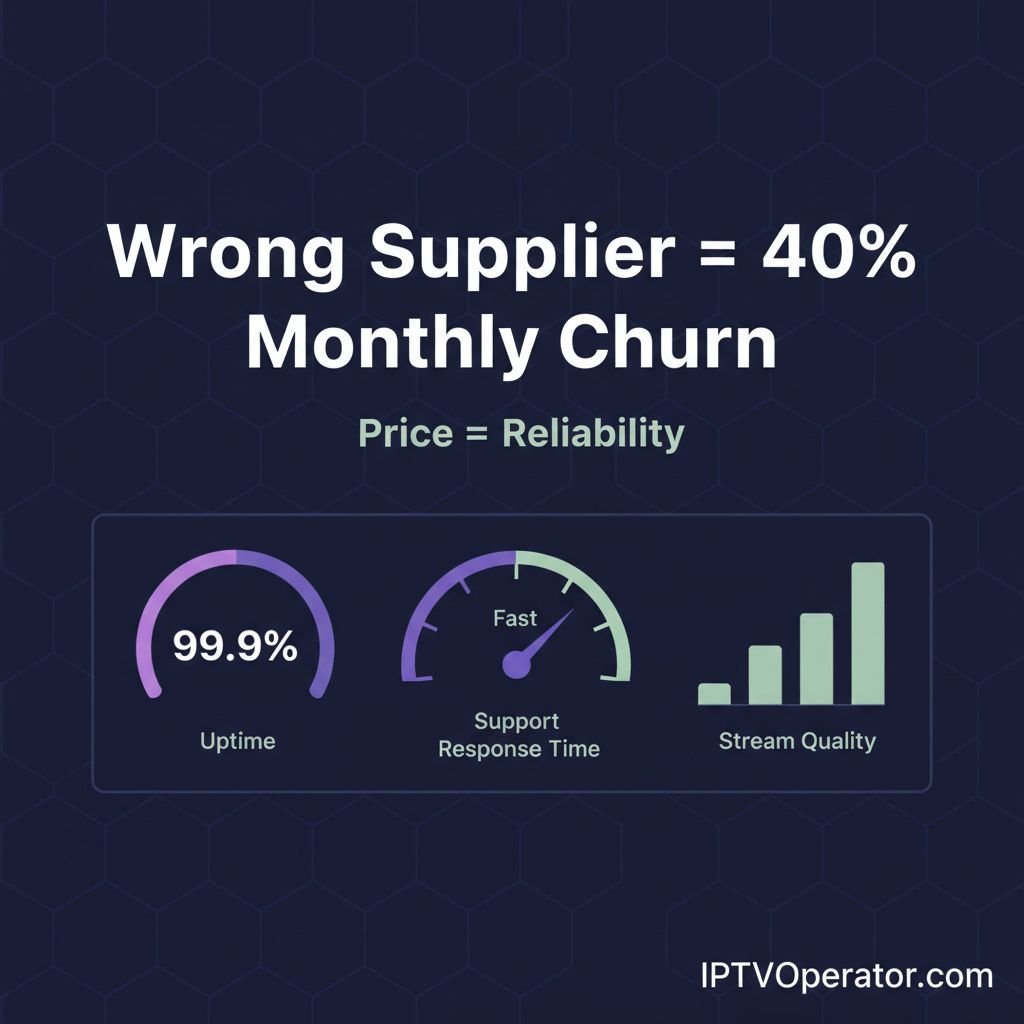
Most new resellers set their price at $10 per month and hit 40% monthly churn before they understand why. A large portion of that churn is not about your customer service or your pricing. It is about stream quality and uptime, which are entirely supplier-dependent. When your customers are buffering during a Premier League match, they are not thinking about your supplier’s infrastructure problems. They are cancelling and moving to the next reseller who promises it will be better.
The resellers who build stable businesses — the ones with 200+ active customers and actual margins — all share one habit: they treat supplier selection as a due diligence process, not a shopping decision. They ask harder questions. They run longer trials. They start small and scale up only after the supplier proves consistent over weeks, not a single test stream.
If you are still figuring out the fundamentals of how to how to start an IPTV reseller business in 2026, the supplier selection decision is the one that will define everything downstream from it. Get it right here and a lot of the other problems become manageable. Get it wrong and you are rebuilding from scratch every few months.
Uptime Guarantees: What to Ask and How to Verify Them
Every supplier claims high uptime. Virtually none of them can prove it. That gap between claim and evidence is where you need to spend serious time before committing any money.
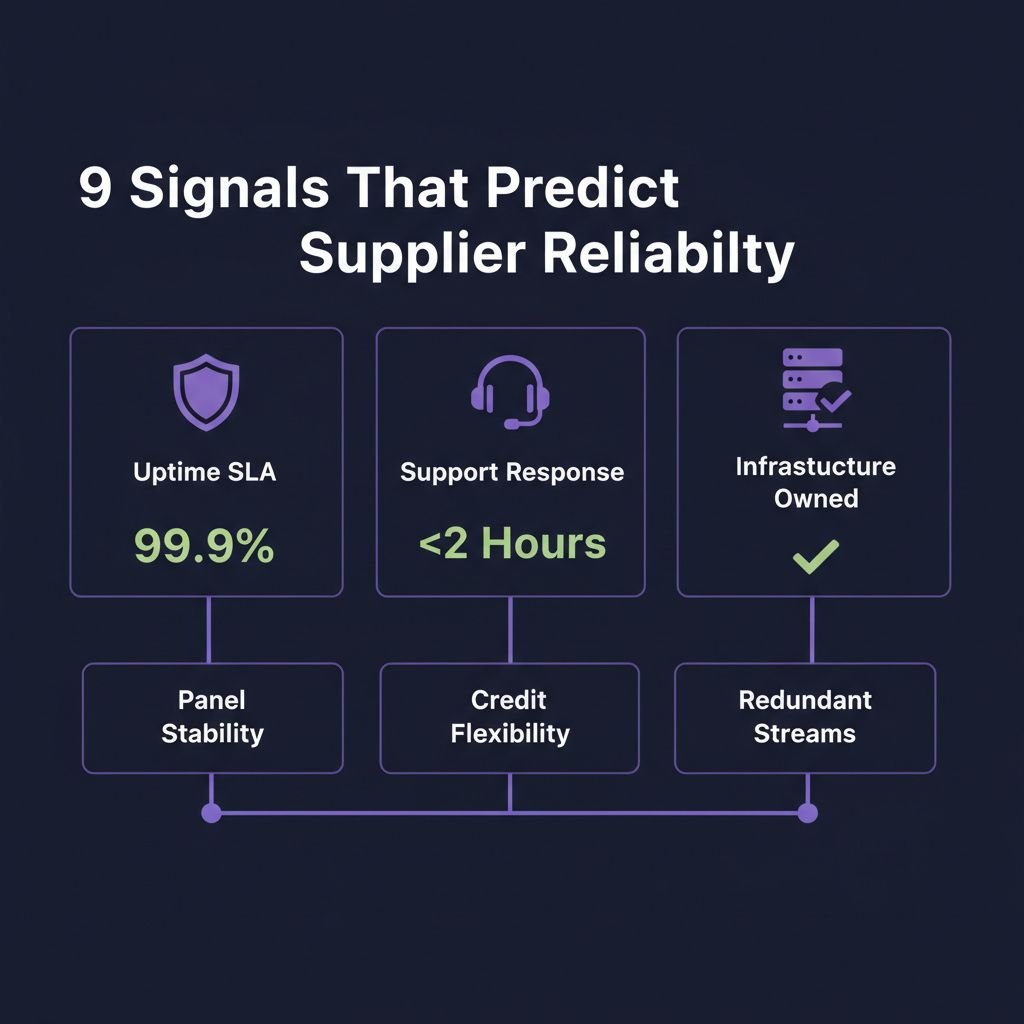
The first thing to understand is what uptime percentages actually mean in practice. 99% uptime sounds excellent until you realise it permits 87.6 hours of downtime per year — roughly 7.3 hours per month. At 99.5% you are still looking at 43.8 hours annually. How SLA uptime percentages translate to real downtime is something most resellers have never actually calculated, and suppliers know that. When a supplier says “99.9% uptime guaranteed,” ask them how they measure it, where the logs are, and what the compensation structure is if they miss it. Silence or vague answers at that point tells you everything.
What a Real Uptime Guarantee Should Include
A legitimate uptime commitment from a wholesale IPTV supplier should include at minimum: a defined measurement methodology (server-side pings, third-party monitoring, or both), a specific percentage tied to a rolling period (monthly is standard), and a defined remedy if they miss it — usually credit compensation. If a supplier cannot articulate all three of those things, they do not have a real SLA. They have a marketing line.
Ask whether they use any third-party monitoring tools you can verify independently. Some suppliers will share a status page. Most will not, but asking puts pressure on them to be specific rather than vague. Also ask about their redundancy setup — do they have failover servers, and in what geographic regions? A supplier running everything through a single server cluster in one location has no real redundancy regardless of what they tell you.
During your trial period, run your own uptime checks using a free tool like UptimeRobot pointed at a test stream URL. Do this for at least two weeks, including across peak evening hours and major live sports events. Those are the stress conditions that expose weak infrastructure. A supplier who holds up during a Champions League night with 50,000 concurrent streams is a very different proposition from one who looks fine at 2am on a Tuesday.
How to Evaluate a Wholesale IPTV Supplier’s Panel and Technical Infrastructure
The reseller panel is not just a dashboard. It is your entire operational layer. The quality of that panel determines how much time you spend on manual account management, how quickly you can onboard new customers, and how much control you have when things go wrong. Evaluating it properly before you commit is non-negotiable.
Most panels in this space are built on how Xtream Codes panel architecture works, or a fork of it. That is not inherently a problem — the architecture is functional and widely supported by players like TiviMate and IPTV Smarters. What matters is what the supplier has built on top of it, and how stable their specific implementation is.
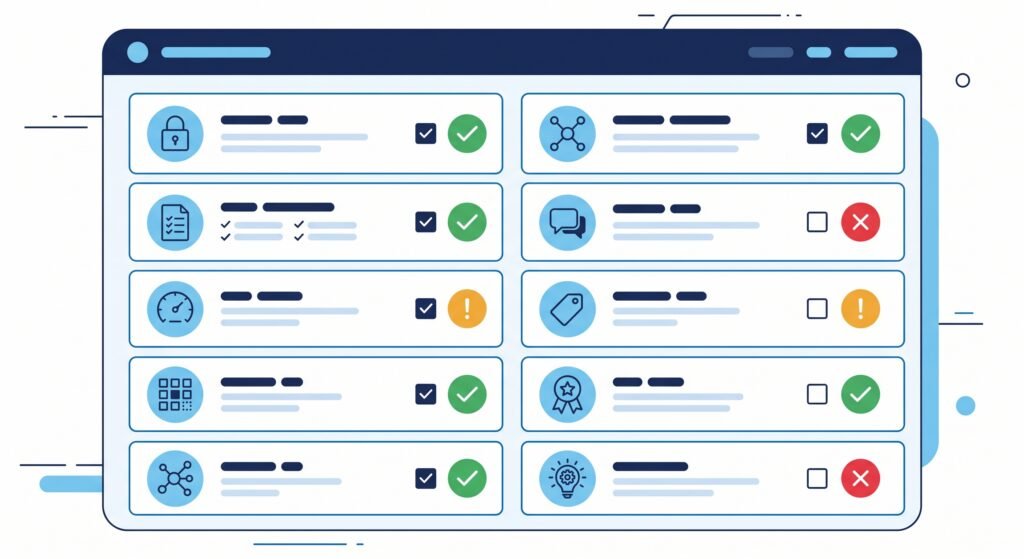
When you are evaluating a panel, look for these specific features: the ability to create and disable individual customer accounts without contacting support, a real-time connections monitor showing active streams per account, bulk account creation or CSV import for scaling, expiry management with automated renewal reminders, and some form of usage reporting. If a supplier’s panel is missing more than two of those, you are going to hit operational friction as soon as you have more than 30 customers.
Branded Panels and API Access
Some wholesale suppliers offer white-label or branded panel options where your customers log in through a domain that looks like your brand rather than the supplier’s generic interface. This matters more than most new resellers realise. If your customers ever see the supplier’s branding, they can go direct. That is not paranoia — it happens regularly once customers learn how the supply chain works.
API access is worth asking about even if you are not ready to use it yet. A supplier who offers API integration means you can eventually connect their panel to your own billing system, automate provisioning, and build a more scalable operation. It is a signal of technical maturity on their end. Check the technical setup every IPTV reseller actually needs to understand what integrations actually matter at different stages of your business.
Also verify whether the panel supports M3U output in addition to Xtream Codes credentials. Some customers will need M3U links for devices that do not support Xtream Codes login. A panel that only outputs one format limits your customer compatibility. For a deeper look at how these two delivery models compare, the breakdown in M3U vs IPTV panel: which wholesale model fits your business covers the practical trade-offs in detail.
Testing Methodology: How to Run a Trial That Actually Tells You Something
A 24-hour trial with two test streams tells you almost nothing. That is the dirty secret of IPTV supplier vetting — most resellers run trials that are too short, too shallow, and conducted at the wrong times to surface real problems. By the time they discover the supplier’s weaknesses, they have already bought credits and onboarded customers.
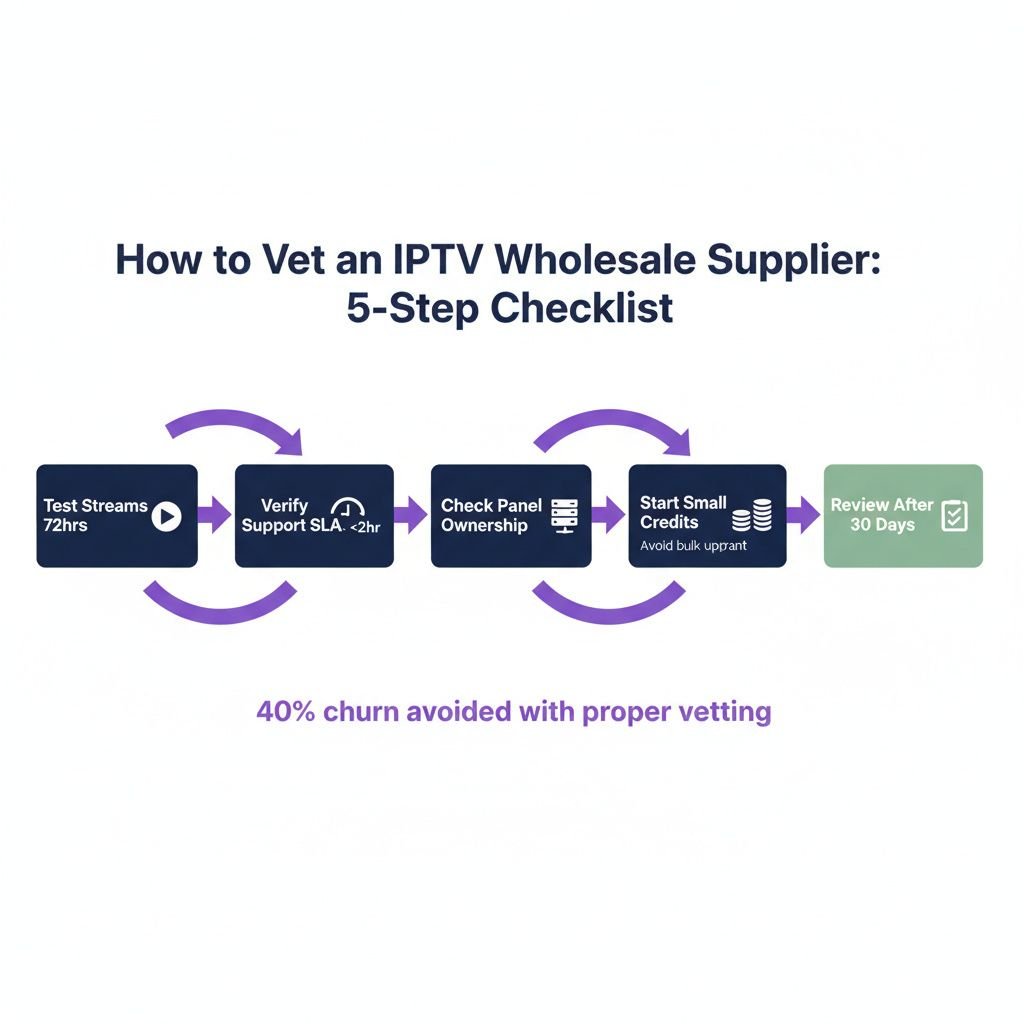
A trial worth running looks like this: minimum 72 hours, ideally 7 days. You want to test during peak hours on weekday evenings (7pm-11pm in your target market’s timezone), during at least one major live sports event, and during a normal off-peak period so you have a baseline comparison. You are not just checking whether streams work. You are checking whether they hold up under load.
Specific things to test during your trial period: buffer frequency on HD channels (more than two buffering events per hour on a stable 50Mbps+ connection is a red flag), 4K stream stability if you plan to sell 4K packages, EPG accuracy (wrong programme information destroys the end-user experience even when streams are technically working), VOD library load times, and catchup functionality if the supplier claims to offer it. Test on at least two different devices and two different player apps. What works fine on TiviMate may behave differently on an Android box running a generic player.
Simulating a Support Request During the Trial
One of the most useful things you can do during a trial is submit a fake support ticket. Report a minor issue — say a specific channel is not loading — and time the response. Not just whether they respond, but how they respond. Do they ask clarifying questions? Do they check logs? Do they give you a generic reply and close the ticket? The quality of that first support interaction is a reliable predictor of what you will get when a real problem hits at 9pm on a Saturday with 20 customers messaging you simultaneously.
Support response time under four hours during business hours is acceptable. Under two hours is good. Over 24 hours for an initial response during a trial — when they are presumably trying to win your business — tells you exactly how low a priority your support requests will be once they have your money.
Payment Terms, Credit Systems, and Minimum Order Red Flags
The financial structure of a supplier relationship is where a lot of resellers get quietly trapped. Credit systems, minimum order requirements, and refund policies are worth understanding in detail before you commit, because they are also where the most common exit traps are buried.
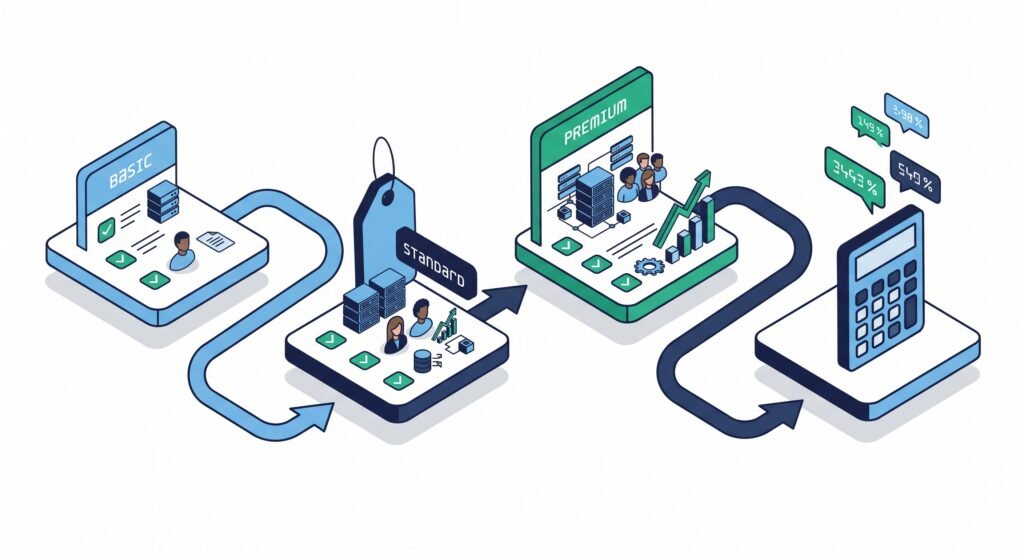
Most wholesale IPTV suppliers operate on a credit system where you pre-purchase credits that you then spend to activate customer accounts. A typical structure might be 1 credit per month per connection, sold in bundles. The economics matter enormously for your margins — check how to calculate your IPTV reseller profit margin before you agree to any pricing structure, because the difference between buying at $1.20 per credit and $1.80 per credit has a significant compound effect across a customer base of 100+ accounts.
Red flags in payment terms include: minimum purchase requirements above 50 credits before you have completed a trial (legitimate suppliers understand why this is unreasonable), no refund policy on unused credits if you decide to leave, payment methods that offer zero buyer protection such as crypto-only with no alternative, and aggressive upsells to larger credit bundles before you have validated the service quality.
Cryptocurrency payments are common in this industry and not inherently a red flag on their own — many legitimate suppliers use crypto because of payment processor restrictions. The red flag is crypto-only with no alternative and no escrow-style arrangement. If something goes wrong, you have no recourse. Some resellers use a staged commitment approach: buy the minimum to test for 30 days, then scale up if the service holds. Any supplier who refuses to work with that approach and insists on large upfront purchases is telling you something important about how they operate.
Also ask explicitly about what happens to your credits and your customer accounts if the supplier shuts down or goes dark. You will not get a contractual guarantee in most cases, but how a supplier responds to that question is informative. A supplier who has thought about business continuity and has a clear answer is operating more professionally than one who deflects or acts offended by the question.
Legal Exposure, Supplier Red Flags, and What Happens When a Supplier Goes Dark
This is the section most buying guides skip entirely, and the omission is significant. Operating as an IPTV reseller in most Western markets sits in a legal grey zone. You are not the content rights holder. You are not the distributor in any licensed sense. You are a downstream reseller of a service that, in most cases, is distributing content without verified rights agreements. That reality does not stop the business from operating — millions of customers use these services — but it does mean your risk exposure is real, and your choice of supplier affects how exposed you are.
Supplier-side red flags that suggest higher legal exposure include: no terms of service document whatsoever, completely anonymous ownership with no verifiable business identity, servers based exclusively in jurisdictions with no copyright enforcement infrastructure, and content packages that explicitly include premium sports rights (Sky Sports, NFL, etc.) with no plausible explanation for how those rights are cleared. None of those things guarantee legal action against you as a reseller, but they do indicate a supplier operating with no concern for compliance, which usually also means no concern for business longevity.
The supplier going dark scenario is more common than most new resellers expect. It can happen gradually — support goes quiet, then streams start dropping, then the panel stops accepting logins — or it can happen overnight. Either way, if you have customers on a supplier who disappears, you have a customer service crisis and a churn event that is very hard to recover from gracefully.
The practical protection is diversification. Experienced resellers typically maintain relationships with two suppliers simultaneously, even if 90% of their customers are on the primary. The secondary supplier is there specifically for failover. It costs you a small amount in maintained trial credits, and it is worth every penny the first time your primary goes dark on a Friday night. For a curated view of stable options worth testing, the best M3U wholesale suppliers for resellers is a reasonable starting point for building that shortlist.
Ask any prospective supplier directly: how long have they been operating? Can they point to any public-facing history — forum mentions, reviews, anything with a timestamp older than six months? A supplier who launched three months ago and is aggressively recruiting resellers with unusually low prices is a specific pattern worth being cautious about. Low prices and new entrants are not always a problem, but the combination of both with no verifiable history is a risk profile you should price into your decision.